

Introduction
A delivery van breaks down on the highway during rush hour. The driver misses three stops. A customer cancels their contract. Multiply that by a fleet of 50 vehicles, and you're looking at real money walking out the door.
This is the exact scenario predictive maintenance was built to prevent.
This guide breaks down predictive maintenance from every angle. You'll learn
- What predictive maintenance actually means and how it works under the hood
- The techniques companies use to catch failures early
- How to calculate its ROI
- What it looks like applied to fleet vehicles versus factory floor equipment
Across manufacturing, energy, and transportation, businesses are ditching the old "run it until it breaks" mindset. In its place: data-driven strategies that catch problems while they're still small and cheap to fix.
Key Takeaways
- Predictive maintenance forecasts equipment failure using real-time sensor data and AI/ML models
- This data-driven approach triggers action only when needed, unlike preventive maintenance's fixed schedules
- Common techniques include vibration, oil, thermal, and acoustic analysis, plus telematics and sensor diagnostics
- Benefits include less downtime, lower costs, longer asset life, and better safety outcomes
- Fleet-focused platforms like Azuga now deliver these insights through GPS and telematics devices
What Is Predictive Maintenance?
Predictive maintenance is a proactive strategy that uses sensors, real-time data, and analytics to catch early warning signs of equipment failure before it happens. Instead of waiting for a breakdown or servicing on a fixed calendar, teams act on what the equipment is telling them.
The financial case is hard to ignore. Siemens' 2024 downtime study found that unplanned downtime costs the world's 500 largest companies roughly $1.4 trillion annually, equal to 11% of their combined revenue.
For a single heavy industry facility, that translates to an estimated $59 million a year in losses. Reactive, run-to-failure maintenance is expensive in ways that rarely show up until the bill arrives.
Preventive maintenance, the fixed-schedule approach, has its own inefficiency problem. The U.S. Department of Energy points out that servicing equipment on a calendar-based schedule often means unnecessary labor, wasted parts, and even incidental damage caused by the maintenance work itself. Teams end up fixing things that didn't need fixing yet.
The 4 Types of Maintenance Strategies
Most organizations fall somewhere on this spectrum
| Strategy | How it works | Best for |
|---|---|---|
| Reactive | Repair only after failure | Low-cost, non-critical equipment |
| Preventive | Servicing on fixed time/usage intervals | Assets with predictable, age-related wear |
| Predictive | Data-driven servicing based on measured degradation trends | High-value or high-risk assets |
| Condition-based (CBM) | Action triggered once a sensor threshold is crossed | Equipment with clear alarm limits |
The distinction between predictive and condition-based maintenance trips people up constantly. CBM reacts the moment a threshold is crossed, say, a temperature alarm. Predictive maintenance goes a step further: it uses trend analysis and machine learning to forecast when that threshold will likely be crossed, often weeks in advance.
How Does Predictive Maintenance Work?
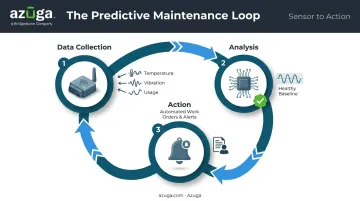
Predictive maintenance runs on a three-stage loop: collect, analyze, act.
Data collection. IoT sensors and connected devices continuously capture metrics like temperature, vibration, pressure, and usage hours. On vehicles and mobile equipment, this same job falls to telematics hardware such as Azuga's battery-powered, hardwired, or Bluetooth beacon trackers mounted to the asset.
Analysis. That data streams to a central system where AI/ML models compare it against a healthy baseline for that specific asset. The models flag subtle anomalies, such as a bearing running slightly hotter than usual or a vibration pattern drifting off normal, long before a human would notice.
Action. When a deviation crosses a meaningful threshold, the system pushes out alerts, automated work orders, or dashboard notifications so maintenance teams can step in before failure occurs.
Common Predictive Maintenance Techniques and Examples
Different equipment types call for different sensing methods
- Vibration analysis: Used on motors, pumps, and compressors to catch misalignment or imbalance. A cereal-production plant used vibration data to catch and precision-balance an out-of-balance motor before it failed on the line.
- Oil analysis: Lab testing of lubricant catches contamination and wear metals early. One documented case at DuPont caught water and fatigue debris in gearbox oil, allowing filtration and repair before failure.
- Thermal imaging: Infrared cameras spot loose electrical connections and overheating components. A refinery using infrared diagnosis on steam traps reportedly saved $600,000 annually.
- Acoustic/ultrasound monitoring: Detects compressed-air leaks, arcing, and abnormal bearing friction through sound.
For vehicles and mobile equipment, the equivalent sensor network is telematics hardware that captures engine RPM, coolant temperature, fuel trims, and diagnostic trouble codes. A 2025 peer-reviewed review of telematics-based machine learning applications notes that models like Random Forest and LSTM networks are increasingly applied to this data to flag maintenance needs before a breakdown happens on the road, not after.
How to Calculate Predictive Maintenance (ROI and Metrics)
Two metrics anchor most predictive maintenance programs
- MTBF (Mean Time Between Failures): Total uptime divided by number of failures. A rising MTBF means fewer failures over time.
- MTTR (Mean Time to Repair): Total repair time divided by number of repairs. A falling MTTR means faster fixes.
Tracking both over months (not weeks) shows whether your program is actually working, not just producing more alerts.
Calculating ROI
The basic formula looks like this
- Add up implementation costs: sensors, software, connectivity, training, and integration
- Estimate avoided costs: downtime hours prevented, emergency labor avoided, parts saved
- Calculate the percentage: (Benefits − Costs) ÷ Costs × 100
- Divide implementation cost by monthly net benefit to get your payback period in months
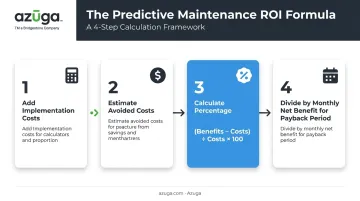
For example, a mid-size truck fleet that invests in sensors and software can often offset that spend by avoiding recurring breakdown costs, with payback measured in months rather than years when the highest-risk assets are prioritized first.
For a planning benchmark, the Department of Energy's operations guide reports that a properly functioning predictive maintenance program can deliver 8-12% savings over preventive maintenance alone. Historical surveys cited in the guide show 25-30% lower maintenance costs and 35-45% less downtime. Treat these as directional, not guaranteed.
Payback period varies a lot depending on asset criticality and industry. Start with a pilot on your highest-value or highest-risk equipment. Validate your numbers there before rolling the program out fleet-wide or plant-wide.
Benefits of Predictive Maintenance
The advantages compound once a program matures
- Reduced unplanned downtime: Early detection lets you fix failures on your schedule, not the equipment's, cutting downtime by 35-45% according to U.S. Department of Energy (DOE) survey data.
- Lower maintenance costs: You stop paying for parts and labor on equipment that didn't need service yet.
- Extended asset lifespan: Continuous monitoring catches wear before it compounds into serious damage.
- Improved safety: Catching failures early reduces the odds of an accident caused by malfunctioning equipment or a vehicle component giving out mid-route.
- Smarter budgeting: When you know what's coming, you can plan parts orders and labor allocation weeks ahead instead of scrambling.
None of this happens automatically. It requires consistent data collection and a team willing to act on the alerts, not just collect them.
Predictive Maintenance for Fleet Vehicles
Fleet vehicles and equipment don't need a full industrial sensor suite. Telematics trackers and condition sensors can expose engine health, diagnostic trouble codes, and increasingly, tire pressure and battery status without adding factory-floor hardware.
For fleet-based businesses like HVAC, plumbing, construction, and trucking companies, the operational impact is direct
- Fewer roadside breakdowns that derail a technician's schedule
- Lower repair bills from catching problems while they're still minor
- Longer vehicle life from consistent, condition-based servicing
Azuga's GPS fleet management platform brings this to fleets without requiring an industrial sensor deployment. Battery-powered, hardwired, and Bluetooth beacon trackers mount to the asset type being monitored and begin capturing data without a complex install. Once connected, the platform surfaces
- Diagnostic trouble codes in real time, viewable on a live dashboard
- Check engine light alerts routed straight to the right person
- Low battery alerts before a dead battery strands a vehicle
- Scheduled maintenance reminders so service happens on time, not late
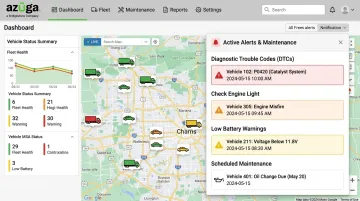
Smith & Solomon, a fleet made up largely of student drivers, used Azuga's DTC monitoring to keep tabs on vehicle condition and catch wear before it turned into a breakdown.
The results show up elsewhere too. Pest control fleets running Azuga have reported a 50% reduction in vehicle breakdowns, directly tied to maintenance alerts that let managers "fix problems before they cause breakdowns."
Compared to building out an industrial sensor network, this is a low-friction entry point, packaged by fleet needs, with no specialized technicians required to get started.
Frequently Asked Questions
How do you calculate predictive maintenance?
Predictive maintenance is typically measured through MTBF and MTTR trends over time, combined with an ROI calculation comparing implementation costs against savings from reduced downtime, avoided emergency repairs, and fewer breakdowns.
What is predictive asset maintenance?
Predictive asset maintenance is the practice of using sensor data and analytics to monitor an asset's actual condition, then scheduling maintenance based on that real condition rather than a fixed time or usage interval.
What are examples of predictive asset maintenance?
Common examples include vibration monitoring on manufacturing motors, turbine condition monitoring in wind energy, and telematics engine diagnostics used across vehicle fleets to flag issues before breakdown.
What are the 4 types of maintenance?
Reactive (fix after failure), preventive (fixed schedule regardless of condition), predictive (data-driven, based on forecasted trends), and condition-based (triggered once a sensor threshold is crossed).
Is predictive maintenance expensive to implement?
Costs vary widely by scale and complexity. Industrial sensor deployments can be a significant investment, while fleet-focused options like battery-powered and hardwired telematics offer a far more affordable entry point.
How is predictive maintenance different from condition-based maintenance?
Condition-based maintenance acts once a sensor threshold is crossed. Predictive maintenance uses historical trends and machine learning to forecast failure before that threshold is even reached.