
That's pushing operations teams away from calendar-based servicing and toward condition-based maintenance (CBM), where the asset itself tells you when it needs attention. This shift isn't confined to factory floors. Construction, trucking, utilities, and waste management companies are now pulling condition data straight from vehicle diagnostics and equipment sensors to keep trucks and machines running longer.
The market reflects that momentum. The global predictive-maintenance market — which includes CBM software, hardware, and services — is projected to reach $17.5 billion in 2026, according to Grand View Research. This guide breaks down the top CBM platforms for both industrial plants and fleet-based businesses.
Key Takeaways
- CBM software triggers work orders from real-time asset data, not a calendar date.
- CBM balances preventive over-maintenance against run-to-failure risk.
- Fleets need OBD-II/telematics platforms; plants need sensor or PLC-based tools.
- This guide ranks five 2026 CBM platforms, including a top pick for fleet monitoring.
Overview of CBM Software in Fleet & Asset-Intensive Industries
CBM software is a digital platform that ingests real-time condition data (sensor readings, PLC tags, or vehicle diagnostic signals) and automatically generates a work order the moment a threshold gets breached. No guessing, no waiting for the next scheduled inspection.
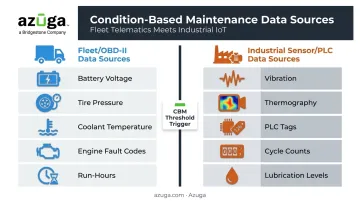
Fleet-based businesses have caught on to something factories figured out years ago: condition data doesn't have to come from a vibration sensor bolted to a motor. Telematics providers now treat OBD data as a legitimate fleet CBM source, capturing signals like
- Battery voltage and oil-life percentage
- Tire pressure and coolant temperature
- Driveshaft vibration
- Brake or wheel-end temperature
Engine fault codes and run-hour data reveal wear long before a truck actually breaks down on a job site. That's why construction crews, HVAC contractors, and waste haulers increasingly treat OBD-II output the same way a plant manager treats a thermography scan.
The list below covers both camps: industrial CBM platforms built around sensors and PLCs, and fleet-specific tools built around telematics, so you can find the right fit for your asset type.
Top 5 Condition-Based Maintenance (CBM) Software Tools for 2026
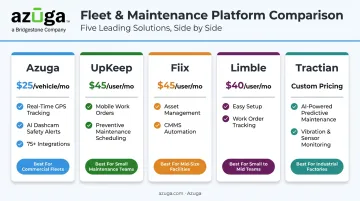
We evaluated each platform on four criteria: breadth of supported data sources (sensors, PLC, OBD-II/telematics), how easily non-technical users can set alert thresholds, mobile work order execution, and fit for a specific industry type.
Azuga
Azuga is a GPS fleet management platform backed by Bridgestone, built specifically for fleet-heavy industries like construction, trucking, utilities, waste management, and towing.
Its plug-and-play OBD-II device, the Azuga Tracker, installs in about 20 seconds and streams engine diagnostics, fault codes, and performance data at 30-second intervals. The moment a condition trigger hits, such as a check-engine alert, abnormal idling, or a harsh-driving pattern, the platform flags it for maintenance action.
Azuga's SafetyCam AI adds collision reconstruction on top of that, giving fleets visual proof of asset and driver condition. It's a similar concept to the computer-vision root-cause tools used in industrial CBM setups.
Azuga's scale backs this up: the company has 400,000+ OBD-II devices deployed, tracking 3 billion annual miles and 300 million trips a year. Pest control fleets using Azuga's maintenance alerts have seen breakdowns drop by 50%, alongside a 29% cut in idling and a 36% reduction in hard braking.
| Category | Details |
|---|---|
| Pricing | packages matched to fleet needs with no hardware installation fees |
| Key Features | OBD-II real-time diagnostics, 30-second GPS tracking, automated maintenance alerts, dashcam-based collision reconstruction, 24/7 support |
| Best For | Fleet and field-service businesses needing condition-based alerts on vehicles rather than stationary industrial equipment |
UpKeep
UpKeep is a mobile-first CMMS built around ease of use, leaning heavily on runtime and meter-based triggers rather than raw sensor feeds.
It connects to building management systems and vehicle or asset meters, giving dispersed teams a simple red/green asset health view. Meter-triggered work orders can fire on conditions like "greater than" a set value or "reaches every" X hours, useful for usage-based tasks like oil changes tied to run hours instead of calendar dates.
UpKeep Edge sensors also track temperature, humidity, or vibration, creating an alert once a reading stays outside threshold for a set duration.
| Category | Details |
|---|---|
| Pricing | Essential and Premium plans; Professional and Enterprise are custom-quoted |
| Key Features | Meter/runtime tracking, mobile technician app, UpKeep Edge sensor alerts, offline mobile mode (Professional/Enterprise) |
| Best For | Facilities teams and mixed fleet/building operations wanting a straightforward mobile experience |
Fiix (Rockwell Automation)
Fiix, owned by Rockwell Automation, is an enterprise CMMS built for factories already invested in the Allen-Bradley/PLC ecosystem.
The Integration Hub connects the CMMS directly to PLCs, sensors, HMIs, MES, DCS, and SCADA systems, pulling run hours, cycle counts, temperature, pressure, and lubrication data to trigger work orders automatically. The Asset Risk Predictor add-on layers AI on top, using sensor readings and historical failure patterns to flag high-risk equipment before it fails.
Rockwell has cited a customer, Perth County Ingredients, using the tool for early warnings before issues escalated (a vendor-reported example worth validating during your own pilot).
| Category | Details |
|---|---|
| Pricing | Free tier available; Basic, Professional, and custom-quoted Enterprise plans (Asset Risk Predictor sold as add-on) |
| Key Features | PLC/sensor Integration Hub, Asset Risk Predictor add-on, enterprise reliability reporting |
| Best For | Large manufacturers standardized on Rockwell/Allen-Bradley hardware |
Limble CMMS
Limble is known for a genuinely easy-to-use interface, plus an IoT module for connecting third-party sensors.
Non-technical users can configure condition rules through Limble's threshold system: a temperature or vibration reading crossing a set point automatically generates a work order, with critical thresholds triggering immediate action and warning thresholds creating lower-priority alerts.
That approachability tends to drive stronger technician adoption than more engineering-heavy platforms. Note that IoT sensor integration currently lives in Limble's Enterprise tier, not the entry-level plans.
| Category | Details |
|---|---|
| Pricing | Standard, Premium+, and Enterprise tiers; contact Limble for plan details |
| Key Features | Threshold-based work order automation, IoT sensor connections (Enterprise), mobile-first technician interface |
| Best For | Small to mid-size teams wanting fast CBM setup without heavy engineering resources |
Tractian
Tractian pairs proprietary Smart Trac vibration and temperature sensors with AI-driven diagnostic software, a sensor-first approach for teams with zero existing data infrastructure.
The sensors mount magnetically in minutes and communicate over a dedicated 915 MHz wireless network, with the receiver pushing data to the cloud via 4G/LTE so no plant IT network is required. Unlike anomaly-only alerts, Tractian's AI names the specific fault: bearing wear, misalignment, cavitation, gear wear, or structural looseness, among others.
One customer, Ingredion, reported over $1 million in production savings and up to 168 hours of avoided downtime after deployment (a vendor-published figure, so treat it as directional rather than audited).
| Category | Details |
|---|---|
| Pricing | Condition-monitoring sensors require a conversation; separate CMMS plans (5-user minimum) |
| Key Features | Smart Trac vibration/temperature sensors, AI-driven fault diagnosis, native SAP integration |
| Best For | Monitoring critical rotating motors and pumps with no existing data infrastructure |
How We Chose the Best CBM Software
The most common mistake we see: buying a heavy industrial sensor platform when a fleet's real condition data (engine codes, mileage, driving behavior) is already sitting in existing telematics hardware.
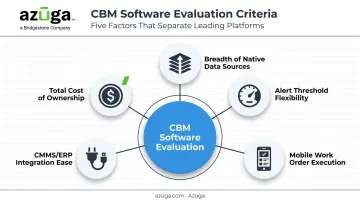
We weighed each platform against outcomes that matter for buyers
- Breadth of native data sources supported
- Flexibility in setting alert thresholds
- Mobile work order execution for field technicians
- Ease of integrating with existing CMMS/ERP systems
- Total cost of ownership, including hardware
Industry fit matters more than brand recognition. An industrial-grade vibration analysis tool is overkill for a plumbing or towing fleet, and a fleet telematics platform won't help a plant manager monitoring rotating equipment on a production line.
Conclusion
There's no universal "best" CBM software. The right answer depends on whether your critical assets are stationary machinery or a moving fleet, not on which brand has the flashiest marketing.
Start small. Pilot on a handful of critical assets, confirm the alert thresholds are actually catching real problems, and check how the platform scales before committing fleet-wide or plant-wide.
If your critical assets are trucks, vans, or heavy equipment on the road, Azuga's OBD-II-based condition alerts and real-time diagnostics are worth a look. They're built to catch mechanical issues before they turn into roadside breakdowns. Call (888) 790-0715 or email customercare@azuga.com to see a demo.
Frequently Asked Questions
What is condition-based maintenance (CBM) software?
CBM software monitors real-time asset condition data (vibration, temperature, engine diagnostics, and similar signals) and automatically triggers a work order once a defined threshold is crossed.
How is CBM different from predictive maintenance?
CBM reacts to condition data crossing a threshold right now. Predictive maintenance adds historical data and algorithms to forecast a future failure date, rather than just responding to present conditions.
Can condition-based maintenance be applied to fleet vehicles?
Yes. OBD-II telematics devices, like Azuga's plug-and-play trackers, capture engine fault codes, idling patterns, and mileage data that function as condition indicators, letting fleets trigger maintenance the same way a factory uses vibration sensors.
How much does CBM software typically cost?
Fleet telematics platforms use packages matched to fleet needs, while enterprise industrial platforms often add sensor and hardware costs on top of software subscriptions.
What sensors or data sources are needed to start a CBM program?
Industrial programs typically rely on vibration analysis, thermography, ultrasonic sensors, and oil analysis. Fleet programs rely on OBD-II and telematics data instead.
What industries benefit most from condition-based maintenance software?
Asset-heavy sectors see the biggest returns: manufacturing, utilities, oil and gas, plus fleet-based trades like construction, trucking, and waste management.