
The real headache isn't understanding that IFTA exists. It's the quarterly grind of tracking miles and fuel purchases across multiple jurisdictions, then reconciling all of it before a deadline. One transposed number or a missed fuel receipt can trigger a correction, added interest, or an audit letter you didn't see coming.
This guide walks through who needs an IFTA license in Washington, how to register, exactly how to file your return, the deadlines and penalties you need on your calendar, and the mistakes that trip up carriers most often.
Key Takeaways
- Washington requires an IFTA license for qualified vehicles (2+ axles over 26,000 lbs, or 3+ axles) operating in WA plus one other IFTA jurisdiction.
- Quarterly returns are due April 30, July 31, October 31, and January 31 — even with zero operations, filing is still required.
- Late returns cost the greater of $50 or 10% of tax due, plus 1% monthly interest on unpaid balances.
- GPS and telematics tracking removes the manual work behind jurisdiction-by-jurisdiction mileage reporting.
What Is IFTA and Who Needs It in Washington?
IFTA lets carriers file one quarterly fuel tax return through their base jurisdiction instead of separate returns in every state or province they drive through. For a Washington-based fleet, that means filing with Washington State Department of Licensing (DOL) rather than juggling paperwork with Oregon, Idaho, California, and anywhere else you run.
Washington is one of 58 member jurisdictions in IFTA — the 48 contiguous U.S. states plus 10 Canadian provinces, according to IFTA, Inc.'s current carrier information. That's essentially the entire lower 48 and most of Canada operating under one shared reporting system.
What Counts as a Qualified Motor Vehicle?
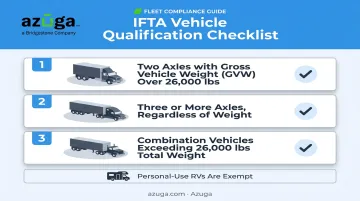
Not every truck needs an IFTA license. A vehicle qualifies if it meets any one of these
- Two axles with a gross vehicle weight (or registered GVW) over 26,000 lbs
- Three or more axles, regardless of weight
- A combination where the total weight exceeds 26,000 lbs
Recreational vehicles like motorhomes and campers are exempt, but only when used exclusively for personal purposes. The moment an RV gets used for business, that exemption disappears.
Do I Need IFTA for Local Trucking in Washington?
If your trucks never leave Washington, you don't need an IFTA license. Intrastate-only carriers still owe Washington fuel tax, but that's handled directly through the state rather than through IFTA's multi-jurisdiction system.
IFTA only kicks in once a qualified vehicle crosses into another member jurisdiction. Some routes, like specific off-highway travel exceeding one continuous mile, may carry distance exemptions.
Tribal land mileage isn't clearly addressed in published IFTA or WA DOL guidance. If that's a regular part of your routes, it's worth a direct call to DOL rather than guessing.
Registering for an IFTA License in Washington
New accounts are set up through WA DOL's License Express portal. You'll sign in (or create an account), select IFTA, and submit your business and vehicle details. Applications by mail are also accepted, though most carriers find the online process faster.
Cost breakdown: There's no application fee, but you'll pay $10 per set of decals (one set required per qualified vehicle).
To use Washington as your base jurisdiction, you need
- A physical business address in Washington
- Operational records maintained or accessible in-state
- Mileage accrued in Washington and at least one other IFTA member jurisdiction
Renewal cycle: Washington IFTA licenses run January 1 through December 31 every year. Renewal applications typically go out during the fourth quarter, with decals available starting November 1.
A grace period has historically extended into the following February for carriers who applied on time but are still waiting on decals to arrive. Confirm the exact dates with DOL each year, since they can shift.
How to File Your Washington IFTA Return
Filing happens through License Express, the same portal used for registration. You'll need an active IFTA account before you can submit a return.
Before you start filing, gather
- Total fuel purchased, broken out by fuel type
- Total miles driven per fuel type
- Receipts for every fuel purchase during the quarter
Diesel and biodiesel are treated as separate fuel types in Washington. Lumping them together throws off your miles-per-gallon calculations and can misstate your tax liability.
Entering Jurisdiction Data
For each jurisdiction you operated in during the quarter, you'll enter
- Fuel type
- Total miles and taxable miles
- Taxed fuel volume purchased in that jurisdiction
Jurisdictions with a fuel surtax require separate line entries — one row with the surtax box checked, one without. Skipping this step is a common source of under- or over-reported tax.
If manual entry sounds tedious for a larger fleet, WA DOL provides an IFTA carrier tax return Excel template for bulk uploads. It has to match DOL's required format exactly, or License Express will reject the file.
Once everything's entered, review your jurisdiction totals, confirm the return, pay any balance due, and save your confirmation number. That number is your proof of filing if a question ever comes up later.
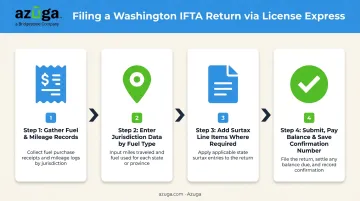
Filing itself is straightforward once the numbers are in hand. The real challenge comes earlier: reconstructing mileage per jurisdiction from paper logs or scattered spreadsheets. This is exactly the gap GPS fleet tracking closes.
Azuga's platform logs vehicle location as often as every 30 seconds, so jurisdiction-by-jurisdiction mileage is already sitting in the system when it's time to file, with no manual reconstruction required. One multi-state carrier, Smith & Solomon, used Azuga's automated mileage reporting to cut roughly two hours a week off their IFTA prep work by eliminating manual mileage calculations.
IFTA Deadlines, Penalties, and Recordkeeping in Washington
Missing a Washington IFTA deadline gets expensive fast, and the schedule doesn't leave much wiggle room.
| Reporting Quarter | Filing Deadline |
|---|---|
| January – March | April 30 |
| April – June | July 31 |
| July – September | October 31 |
| October – December | January 31 |
If a deadline lands on a weekend or state holiday, it shifts to the next business day.
Washington's penalty structure hits hard: late returns trigger the greater of $50 or 10% of tax due, plus 1% monthly interest on unpaid tax starting the first day of the following month.
Here's the part that catches carriers off guard, according to WA DOL's IFTA filing guidance: interest applies per jurisdiction, not just on your overall balance. That means a return showing a net refund can still accrue interest if one specific jurisdiction shows a late-paid liability.
Recordkeeping requirements:
- Keep trip reports, fuel receipts, and vehicle records for at least four years
- WA DOL contacts carriers roughly 30 days before scheduling an audit
- IFTA's Audit Manual sets a benchmark requiring base jurisdictions to audit an average of 3% of reported accounts each year
GPS fleet tracking platforms like Azuga automatically capture mileage and trip data, making this four-year requirement far easier to satisfy than paper logs. That 3% figure means audits aren't rare edge cases. Clean, consistent records are your best defense if your number comes up.
Common IFTA Mistakes in Washington (and How to Avoid Them)
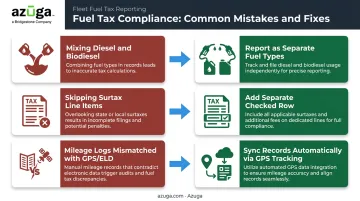
Most IFTA corrections trace back to a handful of repeat offenders.
- Mixing diesel and biodiesel together. They're separate fuel types on the return. Combining them skews your mileage-per-gallon math and can misrepresent tax owed.
- Skipping surtax line items. Surtax jurisdictions need their own row, checked correctly. Missing this step leads directly to under- or over-reported liability.
- Mileage logs that don't match GPS or ELD data. Inconsistent records trigger extra scrutiny during a DOL review and can lead to assessed penalties, even when the error was unintentional.
The real fix for most of these mistakes is better data at the source, not more paperwork after the fact. Platforms like Azuga capture GPS mileage automatically and can pair it with fuel card data, giving fleets a consistent, audit-ready trail. When mileage numbers already match across systems, there's nothing left to reconcile by hand or flag during an audit.
Frequently Asked Questions
How do I file IFTA in Washington?
File through WA DOL's License Express portal after setting up an IFTA account. Enter fuel and mileage data by jurisdiction, then submit payment if you owe a balance.
Do I need IFTA for local trucking in Washington?
No. Carriers operating only within Washington don't need an IFTA license, but they still owe state fuel tax directly. IFTA applies once a vehicle crosses into another jurisdiction.
What are common IFTA mistakes in Washington?
The top three are mixing diesel and biodiesel reporting, missing surtax line entries, and keeping mileage logs that don't match GPS or ELD records. All three commonly trigger corrections or audits. Automated mileage tracking through GPS and ELD systems, such as Azuga's platform, helps keep trip records consistent with actual driving data and audit-ready.
What is the phone number for IFTA Washington?
WA DOL's Motor Carrier Services team handles IFTA questions. Check the current contact number on the DOL's official IFTA page, since department phone lines are occasionally updated.
How much does an IFTA license cost in Washington?
There's no application fee. You'll pay $10 per set of decals, with one set required for each qualified vehicle in your fleet.
How long do I need to keep IFTA records in Washington?
WA DOL requires trip reports, fuel receipts, and related vehicle records to be kept for at least four years in case your account is selected for audit.