
Commercial auto premiums climbed 9.4% year-over-year as of January 2025, up from 7.4% the year before, according to the Ivans Index tracked by Insurance Journal. Add driver shortages, tightening FMCSA enforcement, and thinner margins, and unmanaged risk stops being a someday problem.
Left unchecked, fleet risk leads to costly collisions, compliance violations, and reputational damage that outlasts any single incident. This guide breaks down the risks fleets actually face, how to assess them, which tools help, and how to measure whether your program is working — so you can move from reactive fixes to proactive control.
Key Takeaways
- Fleet risk spans four interconnected pillars: safety, compliance, efficiency, and maintenance, managed as one system
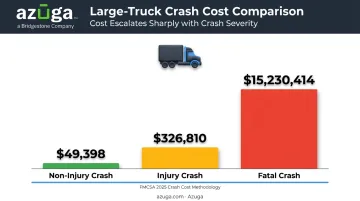
- A single fatal large-truck crash now carries a comprehensive cost of $15,230,414
- Telematics and AI dashcams give managers evidence and early-warning data beyond simple location tracking
- Annual risk assessments plus continuous monitoring catch problems before they become claims
- Track collision rate, safety scores, violations, and maintenance frequency to prove your program works
What Is Fleet Risk Management (and Why It Matters)?
What Is Fleet Risk Management?
Fleet risk management is the ongoing process of identifying, assessing, and reducing the risks tied to your vehicles, drivers, and daily operations. Rather than a one-time reaction to a bad accident, it runs as a continuous loop: watching for hazards, acting on them, and checking whether those actions actually worked.
The discipline rests on four pillars that function together
- Safety: preventing collisions and protecting drivers and the public
- Compliance: meeting DOT, FMCSA, and state regulations
- Efficiency: controlling fuel, routing, and operational waste
- Maintenance: keeping vehicles mechanically sound before they fail on the road
Miss one pillar and the others weaken. A fleet with great safety scores but sloppy maintenance records is still exposed.
Why Fleet Risk Management Is Important
The stakes are measurable, not abstract. In 2023, 5,472 people died in crashes involving large trucks. According to FMCSA's 2025 crash cost methodology, the comprehensive cost of a single fatal large-truck crash now stands at $15,230,414, with an injury crash costing $326,810 and even a non-injury crash costing $49,398.
Beyond the human and financial toll, a documented safety program gives you leverage
- Lower premiums: underwriters respond to demonstrated safety controls, not promises
- Reduced legal exposure: fewer lawsuits and less negative publicity when incidents are rare and well-handled
- Better compliance standing: avoiding fines, out-of-service orders, and CSA score damage
Treating risk management as a pure cost center misses the bigger picture: done well, it functions like an insurance policy that pays for itself before you ever file a claim.
Common Risks in Fleet Management
Most fleet losses trace back to a handful of recurring risk categories. Knowing them is step one toward controlling them.
Vehicle collisions. Speeding, distracted driving, and harsh braking remain the leading contributors. FMCSA's naturalistic driving study found that texting raises the odds of a safety-critical event by 23.2 times, while dialing a phone raises it nearly sixfold. These behaviors offer the biggest opportunity for prevention.
Driver behavior risks. Fatigue, aggressive driving, and inconsistent training compound collision risk. A tired or undertrained driver reacts slower and makes worse decisions under pressure.
Regulatory compliance risks. Missed inspections, expired licenses, and Hours of Service violations lead to fines and damaged CSA scores. FMCSA's Safety Measurement System weighs violations by severity, out-of-service status, and recency, so a pattern of small infractions can hurt as much as one big one.
Vehicle maintenance risks. Skipped inspections and delayed repairs turn small mechanical issues into roadside breakdowns, or worse, safety hazards.
Theft, vandalism, and cargo security. Construction, utility, and trade fleets carry high-value equipment that's an attractive target, and losses hit both the balance sheet and the schedule.
Financial and environmental risks. Fuel price swings and unpredictable weather erode margins and create their own safety hazards when routes or schedules don't adjust.
How to Conduct a Fleet Risk Assessment (5-Step Process)
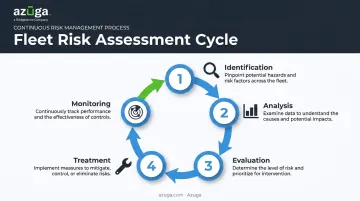
A risk assessment isn't a one-time audit. It's a cycle. Here's the process worth repeating
Identification — Review collision history, maintenance logs, and driver behavior data to surface hazards you may not have noticed yet. This is where hidden patterns, like one driver's repeated near-misses, come to light.
Analysis — Use telematics data and driver scorecards to gauge how likely and severe each risk actually is. Repeated harsh braking or phone use while driving are strong early indicators of elevated crash risk, even without a fixed multiplier attached to them.
Evaluation — Rank risks by severity and frequency. A driver with occasional speeding alerts is a lower priority than one racking up harsh braking events weekly.
Treatment — Apply corrective action matched to the top-ranked risks: targeted coaching, updated policies, or new technology like AI dashcams or telematics platforms such as Azuga.
Monitoring — Set up continuous tracking and revisit the full assessment at least annually, or sooner after a material change in operations or a serious incident.
Most common mistake: Skipping straight to "treatment" without identification and analysis. You end up fixing the loudest problem instead of the biggest one.
Technology and Tools for Modern Fleet Risk Management
Manual spreadsheets and windshield-time observations don't scale past a handful of vehicles. Technology fills the gap.
Telematics and GPS Tracking
Real-time location and driver behavior data, including speeding, idling, harsh braking, and acceleration, let managers catch risk trends before they turn into incidents. Azuga's plug-and-play OBD-II device installs without a technician and reports at 30-second intervals, giving small and mid-sized fleets real-time visibility without a complicated rollout.
AI Dashcams and Video-Based Safety
Dual-facing dashcams with in-cab alerts do two things: they coach drivers in the moment, and they create evidence when disputes happen. Azuga SafetyCam AI with Collision Reconstruction analyzes footage after an incident to reconstruct what happened, which is especially useful since accident fault is often disputed and litigation is expensive regardless of outcome.
Compliance Automation
ELDs, digital DVIRs, and automated HOS tracking cut both violation risk and paperwork. Azuga's Driver Logs application automatically records duty status when a vehicle starts moving, calculates remaining drive time, and warns drivers before they hit HOS limits, removing the guesswork that leads to violations.
Safety Analytics and Reporting Dashboards
Driver scorecards that track braking, speeding, and distraction events help managers target coaching before a pattern becomes a claim. A fleet manager watching for more than two or three harsh braking events in a week from one driver has a concrete, early trigger for intervention rather than waiting for an incident report.
Strategies to Build an Effective Risk Management Program
Tools alone don't create a safety culture. Policy and process do.
- Formal safety policy: Define driver expectations, incident reporting steps, and who's accountable for what, since vague expectations produce vague compliance.
- Ongoing training: Defensive driving, distraction avoidance, and emergency response deserve refreshers, not a single onboarding session forgotten within months.
- Preventive maintenance schedule: Catching a worn brake pad in a scheduled inspection costs less than catching it on the shoulder of a highway.
- Compliance ownership: HOS rules, licensing requirements, and inspection standards shift, so someone on your team, or a platform like Azuga's automated ELD tracking, needs to own staying current.
None of these strategies work in isolation. A great safety policy without enforcement is just a document nobody reads.
Measuring the Success of Your Fleet Risk Management Program
You can't manage what you don't measure. Four KPIs matter most
- Collision rate: trending down over time, not just after a bad quarter
- Driver safety scores: improving on aggregate and for repeat offenders specifically
- Compliance violation counts: fewer HOS, inspection, and licensing issues
- Unplanned maintenance frequency: a proxy for whether preventive maintenance is actually working
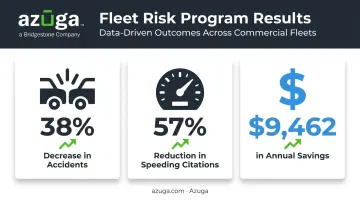
Consistent tracking tells you whether your interventions are working or whether coaching needs to shift focus. Azuga customers report an average 38% decrease in accidents, a 57% reduction in speeding citations, and $9,462 in annual savings. These numbers show what a data-driven program can achieve when KPIs are tracked and acted on, not just collected and filed away.
Frequently Asked Questions
What are the 4 types of risk management?
The four classic strategies are avoidance, reduction, transfer, and retention. In fleet terms: avoid dispatching unsafe vehicles, reduce risk through driver coaching, transfer risk with commercial auto insurance, and retain risk by budgeting for deductibles.
What is the first step in fleet risk management?
Identification comes first — reviewing collision history, driver behavior data, and maintenance records to surface both existing and hidden risks before deciding what to fix.
How often should a fleet risk assessment be conducted?
Most safety experts recommend a full assessment at least annually, paired with continuous monitoring through telematics in between formal reviews.
How can dash cams reduce fleet risk and liability?
AI dashcams provide real-time coaching alerts and video evidence that can exonerate drivers after an incident, cutting down on fraudulent claims and costly litigation.
Does GPS fleet tracking lower insurance premiums?
Demonstrating proactive safety monitoring through GPS and telematics data can strengthen your position when negotiating premiums. It shows insurers you're actively managing risk rather than reacting to it.
What KPIs show that a fleet risk management program is working?
Declining collision rates, improving driver safety scores, fewer compliance violations, and less unplanned maintenance are the clearest signals your program is delivering results.