
Introduction
Your crew shows up to a job site and the generator's gone. Or the trailer that was parked there Friday is missing Monday morning. Sound familiar?
Equipment theft and "misplaced" assets cost field-based businesses real money every year.
Construction equipment theft alone tops $1 billion annually in the US, and less than 25% of it is ever recovered, according to a 2025 report citing NICB data from the American Rental Association.
GPS tracking used to mean vehicles. Now it covers the generators, trailers, tool containers, and heavy machinery that keep field operations running.
This guide breaks down how equipment GPS trackers work, the real benefits they deliver, how they stack up against consumer options like AirTags, and what to look for before you buy.
Key Takeaways
- Equipment trackers come in hardwired and battery-powered forms, each built for different asset types
- Dedicated cellular GPS beats consumer Bluetooth tags for high-value or remote equipment
- The right tracker cuts theft losses and boosts equipment utilization
- Better tracking data sharpens maintenance schedules and billing accuracy
- Azuga pairs rugged equipment hardware with the same platform used for fleet vehicles
What Is a GPS Tracker for Equipment Tracking?
An equipment GPS tracker is a small device attached to non-vehicle assets, think generators, trailers, tool containers, or excavators, that sends location data to a cloud dashboard. You log in, see where everything sits, and get alerts when something moves that shouldn't.
This differs from vehicle fleet tracking in one big way: most equipment has no engine, no battery, and no predictable route. A trailer can sit idle for weeks, then get hitched to any truck on the lot without warning. Tracking hardware has to account for that unpredictability.
How Equipment GPS Trackers Work
The tech flow is simple
- A GPS chip inside the device fixes its location using satellite signals
- A cellular or Bluetooth module transmits that position to a software platform
- The platform plots it on a map and fires off alerts based on rules you set
Update frequency matters more than most buyers realize. A device that reports every few minutes gives you a live picture. One that updates every few hours gives you a stale "last known location." That's far less useful when you're trying to catch a thief in the act instead of filing a police report the next day.
Types of Equipment GPS Trackers
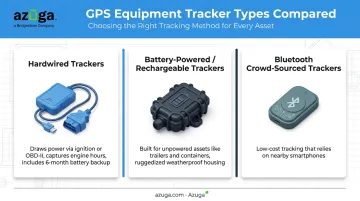
Three main categories cover most field equipment
- Hardwired trackers: Draw power via an ignition or machine power connection, capturing engine hours and diagnostic data for maintenance planning. Azuga's GV620MG Wired Asset Tracker fits generators and compressors, with a six-month battery backup if power is cut.
- Battery-powered/rechargeable trackers: Built for unpowered assets like trailers, containers, and tool boxes, with ruggedized, weatherproof housings for outdoor use. Azuga's Equipment Beacon pairs with the wired tracker to monitor up to 50 beacons via Bluetooth.
- Bluetooth crowd-sourced trackers (AirTag-style): Cheap, low-power options that rely on nearby smartphones rather than independent cellular service. More on this trade-off shortly.
Key Benefits of Using GPS Trackers for Equipment
Theft Prevention and Recovery
Beyond the billion-dollar national theft figure, individual cases show what tracking can accomplish. In 2024, a Virginia contractor's GPS device helped police uncover an estimated $3 million to $5 million cache of stolen construction tools.
Geofencing shortens the recovery window dramatically. Set a virtual boundary around a job site or yard, and you get an instant alert the moment equipment crosses it, especially valuable for after-hours movement.
Improved Utilization and Preventive Maintenance
Idle equipment costs money whether it's running or not. AEM reports that telematics could reduce nonproductive equipment idling by 10-15% on average. That's equipment you could redeploy to another site, rent out, or sell instead of letting it sit.
The same usage data sharpens maintenance timing. Hardwired trackers that capture engine hours let you schedule service based on real usage, not a calendar guess. A generator that ran 400 hours this month needs attention sooner than one that sat idle, reducing unplanned downtime and extending equipment life.
Job Costing, Accountability, and Cost Savings
GPS-verified time-on-site data settles billing disputes fast. If a general contractor questions how long your crew's equipment was on-site, you pull the record instead of arguing from memory. The same data supports usage-based rental billing when you're leasing equipment out.
That same record-keeping extends to accountability. Usage logs help resolve disputes over equipment misuse or damage, creating an audit trail of GPS location, usage, and diagnostic data that holds up when a claim needs proof.
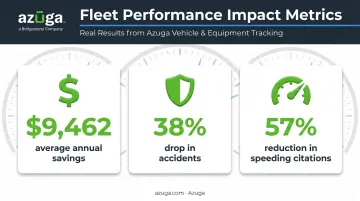
These documented savings add up at the fleet level. Fleets using Azuga report an average annual savings of $9,462, alongside a 38% drop in accidents and a 57% reduction in speeding citations. The platform covers equipment alongside vehicles, so the operational gains extend across both asset types.
GPS Tracker vs. AirTag: Which Is Better for Tracking Equipment?
This comparison comes up constantly, and it deserves a straight answer.
AirTags run on Apple's Find My network. There's no cellular fee because the device relies on nearby iPhones to relay its Bluetooth signal to iCloud. Dedicated equipment trackers use independent cellular or satellite connectivity instead.
That difference shows up fast in update reliability. In low-traffic or rural areas, an AirTag can go hours without reporting because no iPhone passed close enough to detect it. A 2025 academic study on sparse-density areas found AirTag location updates took roughly 10 minutes even at moderate density, and that number climbs in truly remote spots. Cellular GPS trackers report independently of foot traffic.
Here's how the two stack up
| Factor | AirTag | Dedicated GPS Tracker |
|---|---|---|
| Connectivity | Bluetooth via nearby Find My devices | Cellular or satellite, independent |
| Update reliability | Depends on foot traffic | Consistent regardless of location |
| Durability | IP67, not built for job sites | Ruggedized, often IP67/IP68 rated |
| Engine diagnostics | None | Available on hardwired models |
| Upfront cost | per unit | Varies by hardware type |
| Fleet integration | None | Full platform with alerts, reporting |
AirTags aren't built for the demands of active job sites. Purpose-built trackers close that gap with
- Weatherproof, ruggedized housings built for job site abuse
- Hardwired power options for continuous, always-on tracking
- Engine and equipment diagnostics on hardwired and telematics-connected models
- Fleet alerts and reporting through a connected platform
The verdict: AirTags can work fine for low-value tools inside a shop or warehouse with heavy foot traffic. For business-critical equipment on job sites, rental yards, or remote locations, a dedicated GPS platform gives you data you can actually act on. Azuga's cellular trackers, for example, report location every 30 seconds regardless of foot traffic.
Must-Have Features to Look for in an Equipment GPS Tracker
Not every tracker fits every asset. Before buying, check these three areas.
Durability and installation
- Weatherproof, vibration-resistant housing (look for IP67 or higher)
- Plug-and-play or magnetic mounting, no professional installer needed
- Azuga's battery-powered asset trackers install in minutes without a technician, while hardwired options are built for equipment that stays powered continuously
Power and battery life
- Hardwired units draw continuous power and track engine hours
- Battery-powered units should offer months to years of runtime for "set-and-forget" monitoring
- Confirm backup power for hardwired devices in case the equipment's power source is cut
Software depth
- Geofencing alerts for after-hours or unauthorized movement
- Real-time or high-frequency location updates
- Utilization and engine-hour reporting
- Mobile app access so managers can check status from anywhere
Industries That Benefit Most from Equipment GPS Tracking
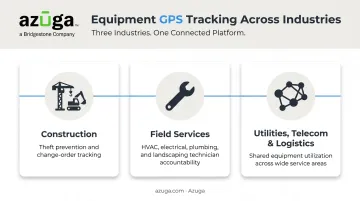
- Construction: Machinery and tools move across job sites daily. Geofence alerts catch theft fast, and usage data backs change-order claims when equipment stays longer than planned.
- Service fleets (HVAC, electrical, plumbing, landscaping, pest control): Generators, trailers, and tools travel between jobs daily. Tracking boosts technician accountability and cuts losses.
- Utilities, telecom, logistics, and waste management: Shared equipment and trailers cover wide service areas. Utilization data directs assets where they're needed instead of sitting idle.
Azuga's equipment and asset management solution pairs rugged tracking hardware with the same platform used for fleet vehicles, backed by 24/7 support. That means one dashboard for trucks, trailers, generators, and tools instead of juggling separate systems. If you're weighing options, a live demo is a fast way to see how it fits your specific asset mix.
Frequently Asked Questions
What is the best way to track equipment?
Pair the right hardware, hardwired for powered equipment, battery-powered for unpowered assets, with a software platform offering geofencing and reporting. The ideal setup depends on your asset value and job site conditions.
Which is better, AirTag or GPS?
AirTags suit low-value, indoor, high-traffic scenarios. Dedicated cellular GPS trackers work better for high-value business equipment needing reliable updates in remote or outdoor environments.
How much does a GPS tracker for equipment cost?
Azuga's fleet plans use packages matched to fleet needs, with equipment tracking quoted based on asset count and hardware type.
Do equipment GPS trackers require a subscription?
Most cellular-based systems charge a monthly fee for dashboard access, alerts, and reporting. Consumer Bluetooth tags may only need a low-cost software add-on instead of a full subscription.
Can GPS trackers track unpowered equipment like generators and trailers?
Yes. Rugged, weatherproof trackers with long battery life handle this exact use case, no power source required.
How does geofencing help protect equipment?
Geofencing creates a virtual boundary around a job site or yard. If equipment crosses that line or moves after hours, you get an instant alert, giving you a much faster shot at recovery than discovering the theft the next morning.