
Here's the problem: most fleet managers spend weeks vetting a provider's shop network, technician credentials, and parts sourcing. They spend far less time reading the fine print that determines what happens when something goes wrong.
This guide breaks down what a fleet maintenance contract actually is, what it needs to include, whether it delivers real ROI, red flags that should stop you before you sign, and how telematics data helps you verify and negotiate these agreements from a position of strength.
Key Takeaways
- Fleet maintenance contracts shift repairs to a paid third party, not your team
- Strong contracts define scope, SLAs, exit terms, data rights, and liability caps
- Contracts boost uptime and budget certainty, except for small, low-mileage fleets
- Independent telematics data proves whether your provider delivers as promised
What Is a Fleet Maintenance Contract?
A fleet maintenance contract is a formal agreement between a fleet and a service provider, whether that's a dealer, a leasing company, or an independent shop network, that covers preventive maintenance, repairs, parts, and labor for a set fee structure.
The core trade-off is simple: you give up some cost variability in exchange for predictability. Instead of absorbing a $4,000 transmission repair bill out of nowhere, you pay a known monthly or per-mile rate and let the provider absorb that risk.
Compare that to fully in-house maintenance, where you control every decision but also carry every dollar of repair risk yourself.
Types of Fleet Maintenance Contracts
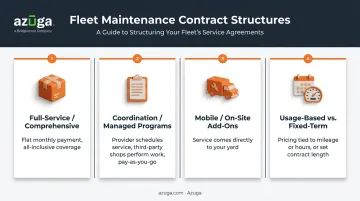
Not all contracts work the same way. The main structures you'll encounter include
- Full-service/comprehensive contracts: bundle preventive maintenance, repairs, and parts into a single agreement, often with one flat monthly payment
- Coordination or managed maintenance programs: the provider schedules and oversees work, but a vetted third-party shop network performs the repairs, typically billed pay-as-you-go
- Mobile/on-site add-ons: service comes to your yard or job site rather than requiring vehicles to travel to a shop
- Usage-based vs. fixed-term models: pricing tied to mileage or engine hours instead of a flat calendar term
On contract length, don't assume there's a universal industry standard. Broader fleet master agreements commonly start with a one-year term that then continues on an evergreen basis unless either party gives notice, according to Automotive Fleet's coverage of fleet contract structures. Multi-year terms exist, but they're negotiated, not default.
What Should Be Included in a Fleet Maintenance Contract?
This is where most fleet managers get burned, not because the provider hides anything, but because vague language slides through unnoticed. Six elements are non-negotiable.
Scope of services. Get an explicit list of what's covered: preventive maintenance intervals, fluid and filter changes, tire servicing, DOT/state inspections, and warranty repairs. Then request an equally explicit list of exclusions, since providers commonly carve out major work like engine rebuilds.
SLAs with real remedies. A response-time target or first-time fix rate is meaningless without a consequence attached. Ask what specific credit, discount, or penalty applies when the provider misses a PM completion percentage or turnaround window, not just whether a number is written down.
Termination and exit terms. Confirm
- The notice period required to prevent auto-renewal
- Early termination fees at different points in the term
- Whether rate escalation at renewal is capped or open-ended
Data ownership. Your contract should guarantee return of your full maintenance history in a usable format (not a PDF screenshot) at contract end, with no export fee. This ties directly to your ongoing DOT compliance recordkeeping obligations.
Liability and insurance. Two questions matter most
- Is the provider's liability for a failed repair capped at invoice value, or does it extend to consequential damages like an accident or lost cargo?
- What are the minimum insurance requirements for the provider and any subcontracted shops it uses?
Pricing and invoicing. Understand whether you're on a fixed rate per vehicle or per mile versus variable billing, and get clear approval steps for anything outside the agreed scope before work starts.
| Contract element | What to confirm in writing |
|---|---|
| Scope | Inclusions and exclusions, listed by service type |
| SLAs | Metric plus financial or operational remedy |
| Exit terms | Notice period, fees, escalation caps |
| Data | Format, retention, no export fee |
| Liability | Invoice cap vs. consequential damages |
| Pricing | Fixed vs. variable, out-of-scope approval process |
Are Fleet Maintenance Contracts Worth It?
For most mid-size to large fleets, yes. The math generally favors predictability. But it's not universal, and the exceptions matter.
Where Contracts Pay Off
Unplanned downtime is expensive. One frequently cited estimate from Element Fleet Management managers puts the cost of vehicle downtime at $448 to $760 per vehicle per day. That figure dates back to 2015 and isn't a universal current benchmark, but it illustrates the scale of the risk a good PM schedule is designed to reduce.
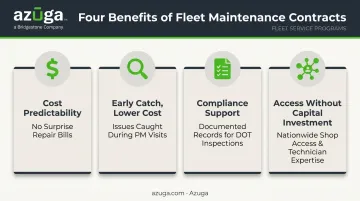
Beyond uptime, contracts typically deliver
- Cost predictability: no surprise five-figure repair bills disrupting your quarterly budget
- Early catch, lower cost: small issues caught during scheduled PM visits before they become major failures
- Compliance support: documented maintenance records that support DOT inspections and reduce mechanical-failure exposure
- Access without capital investment: nationwide shop networks, trained technicians, and parts or tire discount programs you'd otherwise need to build yourself
On the safety side, mechanical condition is a real factor in commercial vehicle crashes. FMCSA's Large Truck Crash Causation Study found brake problems were an associated factor present in 29.4% of sampled trucks involved in crashes.
That's not a causation statistic, and FMCSA is explicit that presence doesn't equal fault. Still, it underscores why consistent brake and mechanical servicing matters for risk management.
Where They Don't
The fixed-fee model isn't automatically the better deal. Contracts may not pencil out for fleets with
- Small vehicle counts and low annual mileage
- Highly variable or seasonal utilization
- An already-efficient in-house shop with trained technicians on payroll
If your in-house team is already hitting strong first-time fix rates and your mileage is unpredictable, you may be paying for a safety net you don't need. Telematics-based maintenance tracking, like Azuga's fleet maintenance management tools, can help you monitor those fix rates and PM compliance so you're making that call with real data instead of a guess.
Red Flags and Questions to Ask Before Signing
Some contract language sounds fine on the surface but leaves you exposed. Watch for these five issues specifically.
- Vague SLA language. Don't accept "the provider will respond promptly." Ask exactly what financial remedy kicks in when a service target is missed.
- One-sided termination or renewal terms. Ask for the precise notice window required to stop auto-renewal, and get exit costs at multiple points in the term, not just year one.
- Unclear data portability. Get it in writing: maintenance history returns in a usable, exportable format at contract end, with no additional fee.
- Uncapped liability exposure. Ask directly whether a failed repair's liability stops at the invoice amount or extends to resulting damages, like an accident caused by that repair.
- Insurance gaps. Verify minimum coverage limits for the provider and every subcontracted shop in its network, plus the notice period required if that coverage lapses.
If a provider hesitates to put any of these answers in writing, treat that hesitation as a reason to keep negotiating or walk away.
How GPS Fleet Tracking Strengthens Your Maintenance Contract Strategy
A signed contract is only as good as your ability to verify it's being honored. This is where independent telematics data changes the equation.
GPS fleet management platforms like Azuga connect to a vehicle's OBD-II port and capture live engine diagnostics, including Diagnostic Trouble Codes (DTCs), alongside odometer mileage and idle time. That data feeds a scheduled maintenance dashboard that lets you track PM-due milestones independently of what your provider reports back to you.
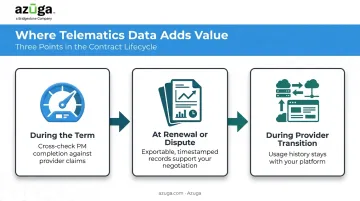
This matters at three points in the contract lifecycle
- During the term — you can cross-check whether the provider's claimed PM completion dates match your own mileage and diagnostic records, rather than relying solely on their invoices
- At renewal or dispute — Azuga's automated, schedulable reports export in PDF or Excel and create a timestamped record you can bring to a negotiation
- During a provider transition — because vehicle usage and diagnostic history live in your own telematics platform, that data stays with your fleet regardless of who's handling maintenance next
Azuga's OBD-II device is plug-and-play, so smaller fleets without a dedicated data team can start building this record without much lift. Plans use packages matched to fleet needs depending on refresh frequency and diagnostic depth. The CompleteFleet tier updates location and vehicle data every 30 seconds, enabling the most granular SLA verification.
The bigger point: you don't need to take a provider's word for whether they're meeting the terms they signed. Your own data can confirm it.
Frequently Asked Questions
What should be included in a fleet maintenance contract?
A strong contract defines scope of services, SLAs with financial remedies (not just targets), termination and exit terms, data ownership guarantees, and liability caps. Pricing structure and out-of-scope approval steps round out the essentials.
Are fleet maintenance contracts worth it?
Yes, particularly for uptime and budget predictability. Value depends heavily on fleet size, mileage variability, and how efficient your in-house shop already is.
What is fleet maintenance?
Fleet maintenance is the ongoing preventive and corrective upkeep of vehicles to ensure safety, compliance, and reliability. A maintenance contract simply formalizes who performs that work and under what terms.
How much does a fleet maintenance contract typically cost?
Most providers quote based on your specific fleet rather than fixed rate cards.
How long do fleet maintenance contracts usually last?
Broader fleet agreements commonly start with a one-year term and continue on an evergreen basis unless canceled. Multi-year terms exist but are negotiated case by case, so review renewal and escalation clauses carefully.
What's the difference between a fleet maintenance contract and an extended warranty?
A maintenance contract covers ongoing scheduled service and repairs across the vehicle's operational life. An extended warranty, by contrast, covers specific defects in materials or workmanship for a limited time or mileage window.