
Introduction
A stolen trailer. An engine failure nobody saw coming. A backhoe that sits idle for three weeks while the crew pays to rent a replacement. Unplanned equipment breakdowns, theft, and idle assets drain profits for service and trade businesses every day.
Many owners only discover a problem after it turns into a costly repair or a missed job.
This guide explains what an equipment monitoring system actually is, the different types available, and how the right one shifts a business from reacting to problems to catching them early.
Whether the "equipment" in question is a delivery van, an excavator, or a trailer full of tools, monitoring technology gives owners the visibility needed to protect what they've already paid.
Key Takeaways
- Sensors, GPS, and software track equipment location, condition, and usage in real time
- Options range from GPS trackers to IoT sensors and RFID/Bluetooth tags
- Benefits include less downtime, faster theft recovery, lower repairs, and stronger safety
- The right system depends on tracking vehicles, mobile equipment, or fixed machinery
What Is an Equipment Monitoring System?
An equipment monitoring system combines sensors or trackers, a connectivity layer, and software to collect and analyze real-time data on where an asset is, how it's performing, and whether it needs attention. Instead of waiting for something to break, the system flags issues before they cause downtime, loss, or accidents.
This is a shift away from "run it until it breaks" management. That approach might work for a $200 power tool. It doesn't work for a $150,000 excavator or a service van that has to be on the road every morning.
Every monitoring system rests on three components:
- The device or sensor: a GPS tracker, hardwired unit, battery-powered beacon, or condition sensor attached to the equipment
- The connectivity: cellular, GPS, or Bluetooth networks that move readings to the cloud
- The software dashboard: the layer that turns raw data into alerts, reports, and trends managers can act on
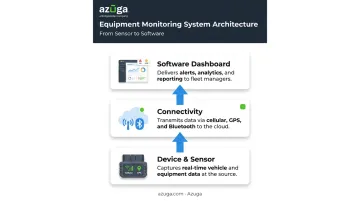
The International Society of Automation describes this same three-layer structure in industrial IoT: a device layer, a network layer, and a service layer that work together to convert raw sensor data into actionable information.
In plain terms, the cycle looks like this: the system measures a condition (location, engine hours, temperature), sends it to the cloud, compares it against a baseline, and alerts a manager the moment something needs a look.
Key Features to Look For in a Monitoring System
Not every platform is built the same way. Before buying, check for
- Real-time location tracking and geofencing: know where equipment sits at all times, with alerts if it leaves a job site
- Utilization and engine-hour tracking: see how much an asset is actually being used versus sitting idle
- Maintenance and diagnostic alerts: flag fault codes or upcoming service intervals before a small issue becomes a breakdown
- Reporting and integrations: connect tracking data with fuel cards, maintenance software, or platforms like ServiceTitan and Fleetio
Types of Equipment Monitoring Systems
Not every asset needs the same monitoring approach. A delivery van, a stationary generator, and a box of hand tools each call for a different type of system.
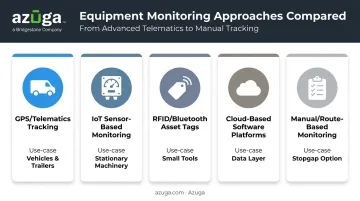
- GPS/telematics tracking: Ideal for trailers, tools, and mobile heavy equipment. Azuga's hardwired and battery-powered asset trackers mount in minutes and update location every 30 seconds.
- IoT sensor-based condition monitoring: Tracks vibration, temperature, and fluid levels on stationary or industrial machinery. Built for predictive maintenance where gradual wear matters more than location.
- RFID and Bluetooth asset tags: Suited for smaller, unpowered tools needing inventory visibility and theft deterrence rather than live location. Readers at tool rooms or gates automate check-in and check-out within 5 to 50 feet.
- Cloud-based software platforms: The layer underneath every sensor type above, turning raw readings into the dashboards, alerts, and reports managers rely on.
- Manual/route-based monitoring: Clipboard checks and spreadsheets. Cheaper upfront but slower to catch problems, making it a stopgap before automated tracking.
Benefits of an Equipment Monitoring System
The payoff shows up in dollars, not just data points.
- Reduced downtime — Siemens' 2024 True Cost of Downtime report found downtime costs top companies $1.4 trillion annually (11% of revenue). Early alerts let teams schedule repairs before failures occur.
- Theft prevention and faster recovery — geofencing and real-time movement alerts help teams recover stolen equipment fast. In one case, a contractor's GPS device led police to a Maryland storage unit holding roughly 15,000 stolen tools worth $3-5 million.
- Lower operational costs — Azuga customers report saving an average of $9,462 per year through better-managed vehicle diagnostics and reduced insurance costs, with some fleets cutting operational costs by up to 30%.
- Improved safety and accountability — video tools like Azuga's SafetyCam AI reconstruct what happened before, during, and after an incident. That evidence has shown roughly 70% of fleet accidents aren't the driver's fault, helping exonerate drivers and avoid costly litigation.
- Smarter utilization decisions — engine-hour and idle-time data show which assets are pulling their weight and which are gathering dust in a yard, informing better rent-versus-buy calls before the next purchase.
- Compliance and audit trail — continuous logs of location, engine hours, and inspection records give businesses documentation to point to during a regulatory review or an insurance dispute.
Industries That Rely on Equipment Monitoring Systems
Different trades put monitoring data to work in different ways
| Industry | How Monitoring Gets Used |
|---|---|
| Construction | Tracks heavy equipment and trailers across job sites, flags unauthorized movement |
| HVAC & plumbing | Monitors service vans between calls, tracks fuel use and technician accountability |
| Landscaping | Manages crews moving between short jobs — arrival times, routing, vehicle location |
| Utilities | Tracks trucks and large equipment across wide territories, separates idle time from productive PTO use |
| Towing | Protects high-value trucks and recovered vehicles with location alerts and geofencing |
| Waste management | Monitors route execution, harsh-braking events, and maintenance needs on stop-start routes |
Scale varies widely. A small business might start by monitoring a handful of vehicles, while an enterprise fleet needs a system that scales across hundreds of assets and multiple locations without losing visibility.
Mobile, vehicle-based monitoring (GPS/telematics) is a different animal from fixed industrial plant monitoring. Most trade and service businesses need the former, not a full industrial IoT sensor deployment.
How to Choose the Right Equipment Monitoring System
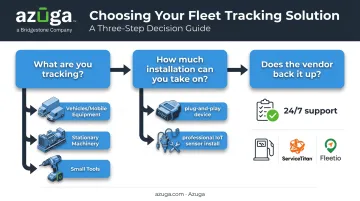
Picking a system comes down to three questions
- What are you actually tracking? Vehicles and mobile heavy equipment call for GPS/telematics, while stationary machinery works best with IoT condition sensors. Small hand tools, on the other hand, are better suited to RFID or Bluetooth tags.
- How much installation are you willing to take on? A hardwired, battery-powered, or Bluetooth beacon tracker that mounts in minutes costs far less time and money than an IoT sensor system requiring professional installation and ongoing calibration.
- Does the vendor back it up? Check for 24/7 support and integrations with tools you already use, such as fuel cards, ServiceTitan, Procore, Fleetio, or TowBook.
Getting this right upfront saves a business from paying for sensor capability it doesn't need — or worse, buying a system too basic to catch the problem that costs the most.
Frequently Asked Questions
What is equipment monitoring?
Equipment monitoring uses sensors, GPS, and software to track an asset's location, condition, and performance in real time. The goal is catching problems, like a failing part or a missing trailer, before they turn into downtime or a loss.
What are the types of equipment monitoring?
The main types are GPS/telematics tracking, IoT condition sensors, RFID/Bluetooth asset tags, and the cloud-based software platforms that tie all of it together into usable dashboards and alerts.
What is an example of an equipment monitoring system?
A common example is a GPS fleet tracking platform paired with hardwired or battery-powered asset trackers that report equipment location, engine hours and condition data, and utilization back to a dashboard in real time.
How much does an equipment monitoring system cost?
GPS/telematics solutions often match packages to fleet needs, while industrial IoT sensor systems typically require a package matched to the number of assets involved.
What's the difference between equipment monitoring and asset tracking?
Asset tracking focuses mainly on an asset's location — where it is and where it's been. Equipment monitoring is broader, also covering condition, utilization, and performance data like engine hours or fault codes.
Do small businesses need an equipment monitoring system?
Often, yes, sometimes more than larger fleets. A single stolen vehicle, missed maintenance issue, or preventable accident can hit a small business's bottom line far harder than it would a large enterprise fleet.