
Introduction
A technician sits idle for 40 minutes because the dispatcher didn't know he'd already finished his last job. Meanwhile, a customer three miles away is still waiting on hold. This is what manual dispatching looks like. It's costing HVAC, plumbing, electrical, trucking, and utility companies real money every single day.
Service dispatch management fixes this by matching the right technician and vehicle to the right job, based on live location, skill set, and availability. It's the difference between a first-time fix and a callback.
The fleet management market is growing fast because of it. MarketsandMarkets values the global fleet management market at $4.52 billion in 2024, projecting growth to $9.17 billion by 2030, a 12.5% compound annual growth rate. This guide breaks down what dispatch management actually does, then ranks the 10 best tools on the market.
Key Takeaways
- Service dispatch management assigns, routes, and tracks technicians and vehicles against incoming job requests in real time.
- The strongest tools pair scheduling with live GPS tracking, not just calendars and forms.
- Pricing models vary by user, by business, or by delivery task, so compare total cost at your actual headcount.
- Fleet visibility (vehicle location, driver safety data) matters as much as scheduling software for dispatch accuracy.
Overview of Service Dispatch Management in the Service Industry
Service dispatch management is the coordinated process of receiving, prioritizing, assigning, and tracking service fleets jobs to available technicians and vehicles. Salesforce describes it plainly: dispatch management oversees the scheduling, planning, and tracking of resources needed to deliver timely service fleets.
It's one function inside the broader fleet management discipline: the piece that decides who goes where, and when.
The old way: a dispatcher on the phone, a whiteboard, and a lot of guesswork about which truck was closest.
The new way: software that pulls in real-time GPS data, technician skill profiles, and job urgency to make that call automatically, or at least suggest the best option in seconds.
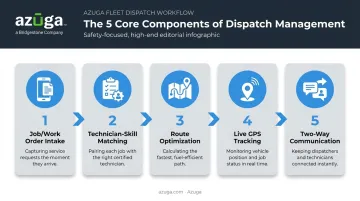
Core Components of Modern Dispatch Management
A functional dispatch system typically includes
- Job/work order intake: capturing service requests from calls, forms, or integrations
- Technician-skill matching: assigning jobs based on certification, experience, or parts on hand
- Route optimization: sequencing stops to cut drive time and fuel spend
- Live GPS tracking: showing dispatchers exactly where every vehicle sits, right now
- Two-way communication: pushing job details to technicians and status updates back to the office
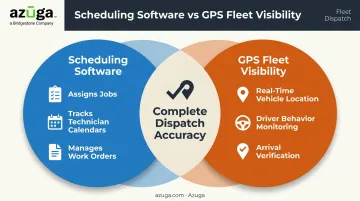
Scheduling software alone doesn't solve the problem anymore. Fleet visibility (where a vehicle actually is, and how the driver is behaving behind the wheel) has become just as central to dispatch accuracy as the scheduling calendar itself. That's exactly why the tools below span two categories: trade-focused scheduling platforms and telematics-driven fleet visibility platforms.
Top 10 Best Service Dispatch Management Tools
We evaluated these tools on five factors: breadth of dispatch features, integration options, industry fit, verified user ratings on platforms like G2 and Capterra, and whether the tool addresses both scheduling and field visibility. Some excel at one; the best operations often run both.
Azuga
Azuga is a GPS fleet management and telematics platform used by construction, HVAC, plumbing, trucking, and utility fleets to support dispatch decisions with real-time vehicle location and driver behavior data.
What sets it apart:
- Plug-and-play OBD-II install, requiring no professional installation
- High-frequency tracking at 30-second intervals on the CompleteFleet plan
- SafetyCam AI with collision reconstruction, built to help exonerate drivers in disputed accidents
Azuga integrates with dispatch-focused platforms including Jobber, giving dispatchers real-time vehicle location alongside job assignment. It's the pick for operations that need fleet safety and location visibility built directly into the dispatch workflow, not bolted on afterward.
Salesforce Service Fleets
Salesforce Service Fleets is an AI-driven platform built on the Salesforce Platform that unifies CRM data with scheduling and dispatch.
Its standout feature is autonomous work order assignment (the system can assign jobs without a human dispatcher clicking a button), paired with real-time technician tracking. This makes it a strong fit for enterprises already running Salesforce CRM.
ServiceTitan
ServiceTitan is an all-in-one fleet management platform built around a visual dispatch board, mobile app, and call booking tools for trades businesses.
What differentiates it: dispatching lives in the same system as invoicing, payroll, and reporting. For a scaling HVAC or plumbing contractor, that means no toggling between five different apps to close out a job. ServiceTitan doesn't publish numeric pricing; expect a custom, seat-based quote.
Housecall Pro
Housecall Pro serves home service professionals with scheduling, dispatching, and payment processing in a single app.
Ease of use is the headline benefit, alongside built-in marketing and online booking tools, useful for small-to-midsize residential service businesses that need customer acquisition, not just job management. Plans scale from Basic to Max (annual billing).
Jobber
Jobber is a customizable, user-friendly fleet management tool popular with small businesses handling scheduling, quoting, and on-site payments.
Route optimization and straightforward simplicity make it a favorite for smaller teams that don't need enterprise complexity.
FieldPulse
FieldPulse is an all-in-one platform for trades (plumbing, HVAC, electrical, septic) combining scheduling, CRM, and invoicing.
Two features stand out: simple packaging tools (a built-in Pricebook for consistent quoting) and franchise management features that keep multi-location businesses aligned.
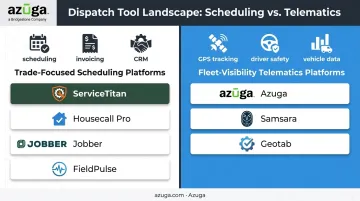
Samsara
Samsara is an enterprise fleet operations platform offering real-time GPS tracking, AI-powered dispatching, and compliance tools like ELD and DVIR.
It's built for scale. Route optimization and driver safety analytics are geared toward large fleet operators managing hundreds of vehicles across multiple job types. Packaging is matched to fleet size.
Geotab
Geotab is an open-platform telematics system enabling vehicle tracking, automated dispatching, and operational analytics.
Its open API and Marketplace app ecosystem sets it apart: businesses that already run a dispatch or ERP system can connect Geotab's telematics data directly into it, rather than replacing existing software. Public rates are not published; expect a reseller conversation or quote.
Onfleet
Onfleet is a last-mile delivery dispatch platform managing both internal fleets and external delivery partners from one system.
Real-time delivery coordination, live driver tracking, and automated customer notifications suit delivery-heavy operations such as courier, grocery, or pharmacy delivery. Pricing is task-volume based: for 2,500 tasks (Launch), up to 10,000+ tasks (Enterprise).
Upper Route Planner
Upper Route Planner focuses on dynamic route planning and dispatch for multi-stop teams.
Real-time route adjustments and driver utilization tracking give it an edge for logistics-focused dispatch operations that live and die by route efficiency. Pricing runs on annual billing (Starter, Professional, Optimize tiers), with monthly equivalents slightly higher.
How We Chose the Best Tools
Feature checklists don't tell you which tool actually fits your operation. We weighed feature depth — scheduling, routing, GPS tracking, communication — against verified user ratings and integration breadth.
Review platforms score tools differently, and it matters. Capterra's Shortlist ranks products on Ratings and Popularity, while G2 weighs Satisfaction and Market Presence. Neither factors in whether a tool fits your trade, so we layered on
- Integration breadth — does it connect to accounting, CRM, or telematics systems you already use?
- Industry fit — was it built for trades, delivery, or enterprise fleets specifically?
- Total cost of ownership — per-user, per-business, or task-volume, normalized to your actual usage
The most common mistake we see: choosing a tool because of brand recognition, not operational fit. A trucking fleet doesn't need Housecall Pro's booking widget, and a two-truck plumbing outfit doesn't need Samsara's enterprise compliance suite.
Feature count matters less than impact. The right tool cuts response times, lowers fuel and overtime costs, and keeps customers on schedule.
Businesses managing both technicians and vehicles should weigh fleet-visibility capabilities — GPS tracking, driver safety data — as heavily as traditional scheduling features. Scheduling software tells you who's assigned; GPS tells you where they actually are.
Conclusion
The right dispatch partner matches how your team actually works, not the one with the biggest name. Weigh technician skill-matching, route efficiency, and communication tools against your daily operations, not a vendor's marketing page.
Before committing, pilot-test two or three shortlisted platforms. Watch how they handle your busiest day, not your quietest one. Then reassess scalability, integration ease, and total cost across your full technician and vehicle count.
Once you've settled on a platform, remember that scheduling software solves only half the equation. Pairing it with real-time GPS fleet visibility (like Azuga's telematics platform) closes the gap between assigning a job and knowing it's actually getting done. If your dispatch team is flying blind on vehicle location, request a demo to see what that visibility looks like in practice.
Frequently Asked Questions
What does the dispatch department do?
A dispatch department receives service requests, then assigns qualified technicians or vehicles based on location, skill, and availability. It monitors each job through completion, adjusting assignments as conditions change.
What's the difference between dispatch management and fleet management?
Dispatch management is one function within the broader fleet management discipline: scheduling, assigning, and tracking jobs. Fleet management also covers invoicing, inventory, and reporting.
How much does dispatch management software typically cost?
Fleet telematics like Azuga matches packages to fleet needs.
Which industries benefit most from service dispatch management software?
HVAC, plumbing, electrical, trucking, utilities, and pest control businesses see the biggest impact, since technician and vehicle coordination directly drives revenue and customer retention in these trades.
Can small businesses use dispatch management software effectively?
Tools like Jobber and Housecall Pro are built specifically for small teams, with simple setup and plans at entry level.
How does GPS tracking improve dispatch efficiency?
Real-time vehicle location lets dispatchers assign the closest available technician instead of guessing. It also verifies arrival times and helps identify wasted travel or idle time before it adds up.