
Introduction
A backhoe breaks down mid-job. A delivery van's transmission fails on a Friday afternoon. A factory conveyor jams during a production run. For businesses managing physical assets without a system to track them, these moments feel random.
They usually aren't. They're the predictable result of reactive maintenance and guesswork.
Enterprise asset management (EAM) exists to break that cycle. It's the structured practice of managing physical assets, from manufacturing equipment to construction fleets, across their entire operating life instead of scrambling to fix them after they fail.
This article covers what EAM means, the features that make EAM software useful, how it compares to CMMS and ERP systems, real industry examples, and how the same principles apply directly to vehicle-heavy businesses.
Key Takeaways
- EAM manages physical assets from planning and acquisition through operation, maintenance, and disposal.
- Software, data, and process combine to cut downtime, extend asset life, and lower operating costs.
- Unlike CMMS (maintenance only) or ERP (entire business operations), EAM focuses specifically on managing assets.
- Fleet-heavy businesses apply EAM principles to vehicles through GPS platforms like Azuga.
What Is Enterprise Asset Management (EAM)?
Enterprise asset management is the practice of managing an organization's physical assets, including equipment, machinery, vehicles, buildings, and infrastructure, throughout their entire lifecycle using integrated software, data, and processes. Instead of reacting to breakdowns, EAM gives teams a structured way to plan maintenance, track costs, and make decisions based on real asset condition rather than guesswork.
IBM frames EAM similarly: a combination of software, systems, and services used to maintain and control operational assets across their lifecycle, with the goal of optimizing utilization while reducing operating costs. ISO 55000 describes the underlying discipline as the coordinated activity an organization undertakes to realize value from its assets.
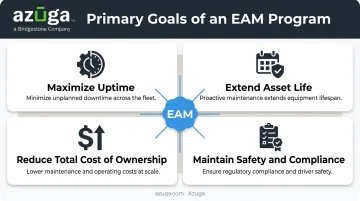
Four goals define most EAM programs
- Maximize uptime and performance by catching issues before they cause failures
- Extend useful asset life through consistent, condition-based maintenance
- Reduce total cost of ownership by balancing repair, replacement, and operating expenses
- Maintain safety and regulatory compliance with auditable inspection and maintenance records
Why Enterprise Asset Management Matters
Unmanaged or reactively managed assets create substantial financial exposure. According to Siemens' 2024 True Cost of Downtime report, unplanned downtime costs the average large industrial plant $253 million per year across the automotive, consumer goods, heavy industry, and oil and gas sectors.
That figure is a modeled estimate, not a guarantee for every plant. Still, it captures a real pattern: equipment failures rarely stay isolated. One unplanned outage can cascade into missed deadlines, safety incidents, and emergency repair bills that dwarf the cost of routine maintenance.
EAM addresses this on three fronts
- Uptime: predictive scheduling curbs the wear that leads to costly, unplanned downtime like the figures above
- Safety and compliance: auditable inspection records support regulatory requirements like OSHA or DOT mandates
- Cost control: planned service typically costs far less than emergency repairs and the downtime that comes with them
The Asset Lifecycle EAM Manages
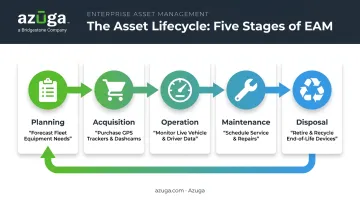
EAM doesn't manage assets at a single point in time. It connects data across five stages, so early decisions (what to buy) inform later ones (when to replace it).
| Stage | What Happens | Example |
|---|---|---|
| Planning | Forecasting needs, budgeting, choosing repair vs. replace | Deciding whether to buy a new excavator or extend an existing one |
| Acquisition | Purchasing, commissioning, and registering assets | Assigning a new HVAC unit an ID and install date |
| Operation | Tracking daily use, condition, and performance | Monitoring engine hours on a fleet vehicle |
| Maintenance | Scheduling preventive, predictive, and corrective work | Replacing brake pads before they fail, based on wear data |
| Disposal | Retiring, reselling, or recycling assets | Selling a forklift once repairs cost more than it's worth |
The Institute of Asset Management's 2024 framework organizes these same activities into five phases
- Planning and creation
- Acquisition
- Operation
- Maintenance and renewal
- End of life
The real value comes from connecting data across every stage. An asset's maintenance history should inform the next purchasing decision, not sit forgotten in a spreadsheet.
Key Features and Capabilities of EAM Software
Most EAM software shares a common set of capabilities, regardless of industry
- Asset lifecycle tracking: a centralized digital record of each asset's location, condition, maintenance history, and depreciation
- Maintenance management: scheduling and executing preventive, predictive, and corrective work orders to avoid unplanned failures
- Inventory and spare parts management: linking stock levels to maintenance needs, preventing stockouts and costly overstocking
- Compliance and safety reporting: maintaining auditable inspection records to satisfy industry regulations and audits
- Mobile and field access: letting technicians update work orders and capture asset data in real time, even offline
Where Predictive Analytics Changes the Math
Predictive analytics is the newest EAM capability, and the most valuable one. IoT sensors feed continuous condition data into the platform, and AI models flag likely failures before they happen, shifting maintenance from a calendar-based guess to a data-based prediction.
The payoff is measurable. McKinsey's research on distributed fixed-asset maintenance found that companies which successfully digitized and automated maintenance cut maintenance costs by 20% to 30%. That matters because maintenance can consume 20% to 60% of operating expenditure, depending on the industry and asset type.
Those savings aren't automatic. McKinsey has also warned that false-positive alerts can make predictive maintenance more expensive than the problem it's meant to solve, prompting unnecessary shutdowns. The technology works best when paired with clean data and realistic thresholds, not blind trust in every alert.
EAM vs. CMMS vs. ERP: Understanding the Differences
EAM often gets confused with two other systems. Each serves a different purpose, and knowing the boundaries helps you pick the right tool instead of overpaying for capability you don't need.
EAM vs. CMMS: What's the Difference?
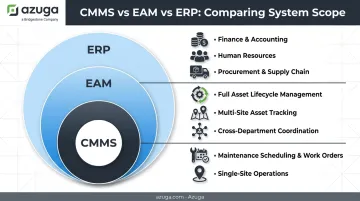
A computerized maintenance management system (CMMS) focuses narrowly on maintenance: scheduling work orders, logging repairs, and tracking maintenance history, typically for a single site. EAM covers more ground, spanning the full asset lifecycle across multiple departments, including finance and compliance.
Gartner draws this distinction directly: CMMS is generally suited to smaller-scale, single-site applications with less functionality. EAM, by contrast, operates at enterprise scale across maintenance, reliability, engineering, and operations teams.
| Aspect | CMMS | EAM |
|---|---|---|
| Primary goal | Organize maintenance work | Optimize performance, risk, and cost across the asset lifecycle |
| Scope | Single site, maintenance-focused | Multi-site, cross-department |
| Typical users | Maintenance teams | Maintenance, finance, operations, compliance |
Think of a CMMS as one component that often lives inside a broader EAM strategy, not a competing system.
Is EAM the Same as ERP?
No. Enterprise resource planning (ERP) is broader still. It integrates asset data with finance, HR, procurement, and supply chain into one unified system built around a central transactional database.
EAM can exist two ways
- As a standalone specialized system focused entirely on physical assets
- As one module inside a larger ERP platform, alongside accounting, payroll, and procurement
Which setup makes sense depends on complexity. A hospital system running dozens of buildings, biomedical equipment, and vehicles might need full ERP-level EAM. A plumbing contractor running 15 trucks doesn't.
For businesses with simpler, single-asset-category needs, like a vehicle fleet, a purpose-built and affordable tool typically delivers more practical value than an enterprise ERP module designed for a much bigger problem.
Industries and Real-World Examples of Enterprise Asset Management
EAM shows up anywhere physical assets carry real operational risk
- Manufacturing: production line equipment, robotics, and facility infrastructure
- Energy and utilities: power lines, substations, pipelines, and generation equipment
- Healthcare: biomedical devices, HVAC systems, and building infrastructure
- Government: public buildings, transit systems, and vehicle fleets
- Construction: heavy equipment, tools, and project vehicles
- Transportation: trucks, rail systems, and logistics infrastructure
A utility company offers a clear example. Power line assets span thousands of miles, aging at different rates depending on weather exposure and load.
Using EAM, the utility tracks each pole and transformer's inspection history and schedules preventive maintenance based on condition rather than a fixed calendar. This approach flags components approaching failure before they cause an outage, shifting maintenance from reactive to predictive.
The same logic applies across other asset-heavy sectors. Rail networks, distribution fleets, and municipal transit systems increasingly favor condition-based upkeep over fixed schedules, since it catches failures before they disrupt operations.
The common thread: "assets" isn't limited to factory machines. It spans buildings, IT hardware, medical equipment, and, for a huge share of asset-intensive businesses, vehicles.
Fleet and Vehicle Asset Management: A Specialized Application of EAM
Commercial vehicles are some of the most valuable, and highest-risk, physical assets a business owns. For construction, HVAC, plumbing, landscaping, and trucking companies, one truck represents a rolling investment worth tens of thousands of dollars. Its downtime doesn't just cost a repair bill. It costs a missed job.
The numbers back this up. ATRI's 2026 operational cost report found the average cost to operate a truck reached $2.336 per mile in 2025, with repair and maintenance costs alone rising 8.6% year over year. Every mechanical surprise adds directly to that figure.
Applying EAM Principles to Vehicles
GPS fleet management software applies the same core EAM logic used in a manufacturing plant or utility grid, just aimed at vehicles instead of fixed equipment
- Real-time location and utilization tracking: pinpointing vehicle position and idle time across the entire fleet
- Vehicle health monitoring through telematics diagnostics: reading diagnostic trouble codes before they become breakdowns
- Maintenance scheduling tied to mileage or engine hours: replacing guesswork with condition-based service
Azuga applies this model directly. Its battery-powered, hardwired, and Bluetooth beacon trackers read diagnostic and condition data and surface it live on the fleet dashboard, giving managers the same kind of condition monitoring an EAM platform delivers for a factory line.
GPS tracking refreshes as often as every 30 seconds on the CompleteFleet plan, supporting real-time dispatch and utilization analysis. Odometer mileage, engine diagnostics, and fuel data feed into a digital maintenance record, so service intervals are based on actual usage instead of a fixed calendar.
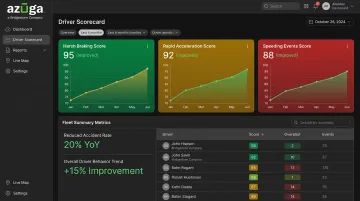
Driver behavior scoring adds a layer most factory-focused EAM systems never need to consider: a truck's condition depends partly on how it's driven. Azuga tracks harsh braking, rapid acceleration, and speeding, then rolls those into a Driver Scorecard.
Fleets using this scoring see measurable results, including an average 38% reduction in accidents across Azuga's customer base, along with fewer costly, unplanned breakdowns.
Real customers reflect this. Diamond Engineering used Azuga's driver and asset location data to secure a 10% discount on its commercial insurance premium. Joseph T. Berrena Mechanicals used the Fleet Maintenance Module's preventive alerts to cut down on the mechanical surprises that come with a shared vehicle pool.
For businesses that don't need full ERP-level asset management, a purpose-built platform like Azuga makes enterprise-style asset tracking accessible without the enterprise price tag or implementation timeline. Requesting a fleet demo is usually the fastest way to see how the same data model applies to a specific fleet.
Frequently Asked Questions
What does enterprise asset management do?
EAM tracks, maintains, and optimizes physical assets across their entire lifecycle, from acquisition to disposal, to reduce downtime, extend useful life, and control operating costs.
What is an example of enterprise asset management?
A utility company using EAM software to track power line assets, schedule preventive maintenance based on condition data, and avoid service disruptions is a common example. Fleet businesses apply the same approach to vehicles.
Is enterprise asset management the same as ERP?
No. ERP is broader, integrating asset data with finance, HR, and supply chain into one system. EAM can exist as a standalone system or as one module inside an ERP platform.
What is the difference between EAM and CMMS?
A CMMS focuses narrowly on maintenance scheduling and work orders, typically for a single site. EAM covers the full asset lifecycle across departments like finance, compliance, and operations.
What industries use enterprise asset management software?
Manufacturing, energy and utilities, healthcare, government, construction, and transportation all rely on EAM to manage equipment, facilities, and fleets at scale.
Is fleet management a form of asset management?
Yes. Vehicles are physical assets with their own lifecycle, maintenance needs, and depreciation curve. GPS fleet platforms like Azuga apply the same principles, tracking condition and triggering maintenance alerts for each vehicle.