
This article covers what truck telematics actually is, how the technology works, real benefits fleets see, what it costs, and the legal rules around tracking. We'll use Azuga's OBD-II based GPS fleet management platform as a working example throughout, since it illustrates how these systems function in practice.
Key Takeaways
- GPS, OBD-II diagnostics, and cellular data give fleets real-time vehicle and driver visibility
- Azuga customers report a 38% average drop in accidents and 57% fewer speeding citations
- Tracking company-owned trucks is legal in the US, but driver notification is required for compliance
What Are Truck Telematics Systems?
Truck telematics blends telecommunications, GPS positioning, and onboard diagnostics into one system that monitors vehicle location, engine performance, and driver behavior simultaneously. In practice, it turns live vehicle data into fleet insights you can monitor from any connected device.
Core hardware typically includes:
- An OBD-II or CAN-BUS device that plugs into the vehicle's diagnostic port
- A GPS receiver for location tracking
- Internal sensors (accelerometers) that detect harsh braking or acceleration
- A SIM card and cellular modem for transmitting data
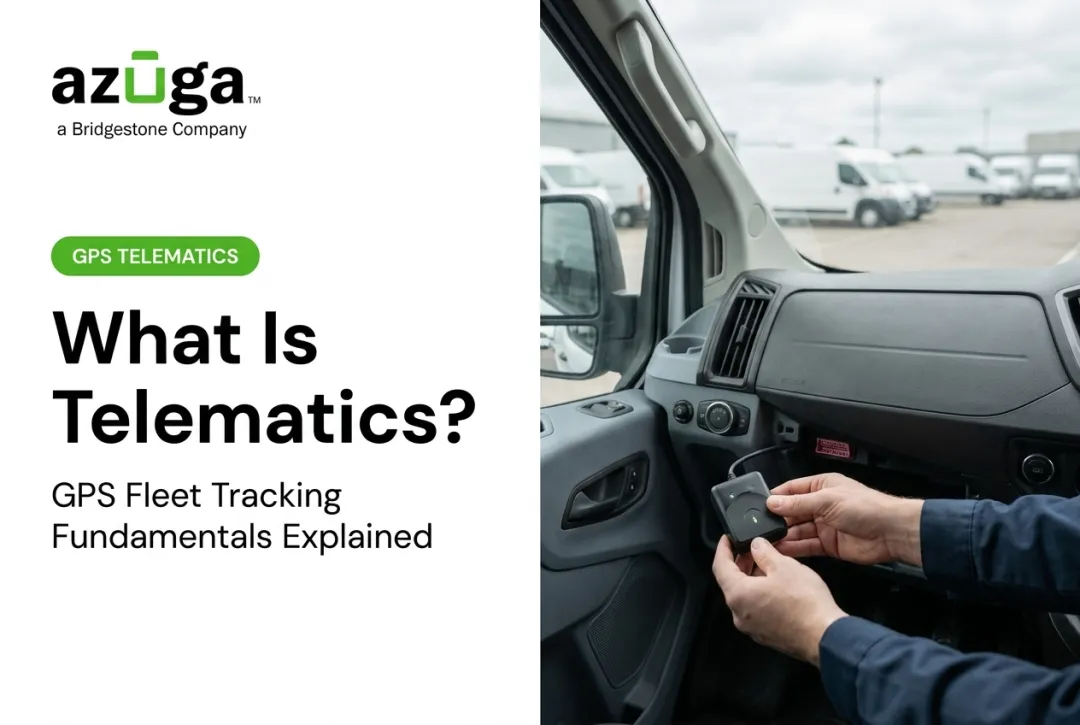
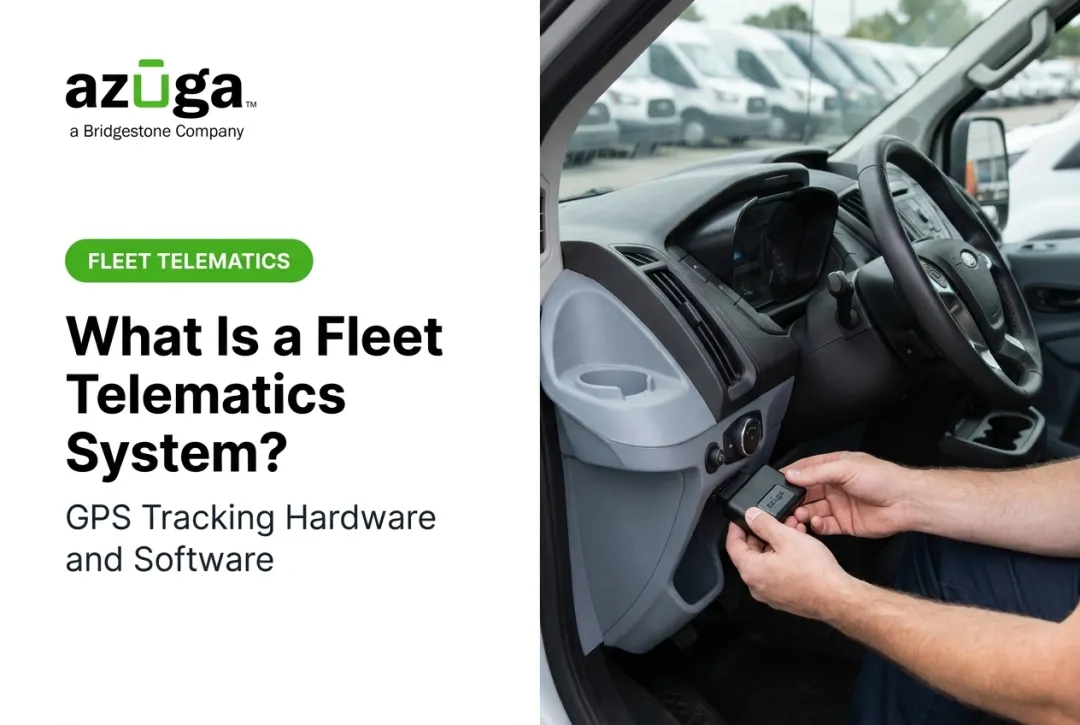
Azuga's tracker plugs directly into a truck's OBD-II port. It interfaces with the vehicle's computer and GPS satellites, combines that feed with sensor data, and transmits everything as encrypted telematics data.
Basic GPS Tracking vs. Full Telematics
Here's where a lot of confusion happens. A basic GPS tracker tells you where a truck is. Full telematics tells you where it is, how it's performing, and how the driver behind the wheel is operating it.
Full systems capture
- Vehicle location and speed
- Engine diagnostics and fault codes
- Driver behavior (harsh braking, speeding, idling)
- Fuel consumption patterns
That distinction matters when you're comparing vendors — don't assume "GPS tracking" and "telematics" are interchangeable terms.

How Truck Telematics Systems Work
The data flow is straightforward once you break it down. A device plugs into the OBD-II port, pulls engine and GPS data continuously, and transmits it over a cellular network to cloud-based software where it becomes usable information.
Azuga's device reads vehicle engine data every second and feeds that activity to the fleet portal in near real time. The tracker installs in about 20 seconds without professional help, with no downtime or shop visit.
What Data Gets Captured
- Location and speed: live map positioning updated frequently
- Harsh braking and acceleration: flags risky driving patterns
- Idling time: identifies wasted fuel
- Engine fault codes: surfaces maintenance issues early
- Fuel consumption: tracks efficiency trends over time
Fleet management software then turns this raw feed into dashboards, safety reports, maintenance logs, and custom alerts. One Azuga customer, Triton Air, configured 11 customized alerts (including check-engine-light notifications) routed directly to the right personnel.

Adding a Video Layer
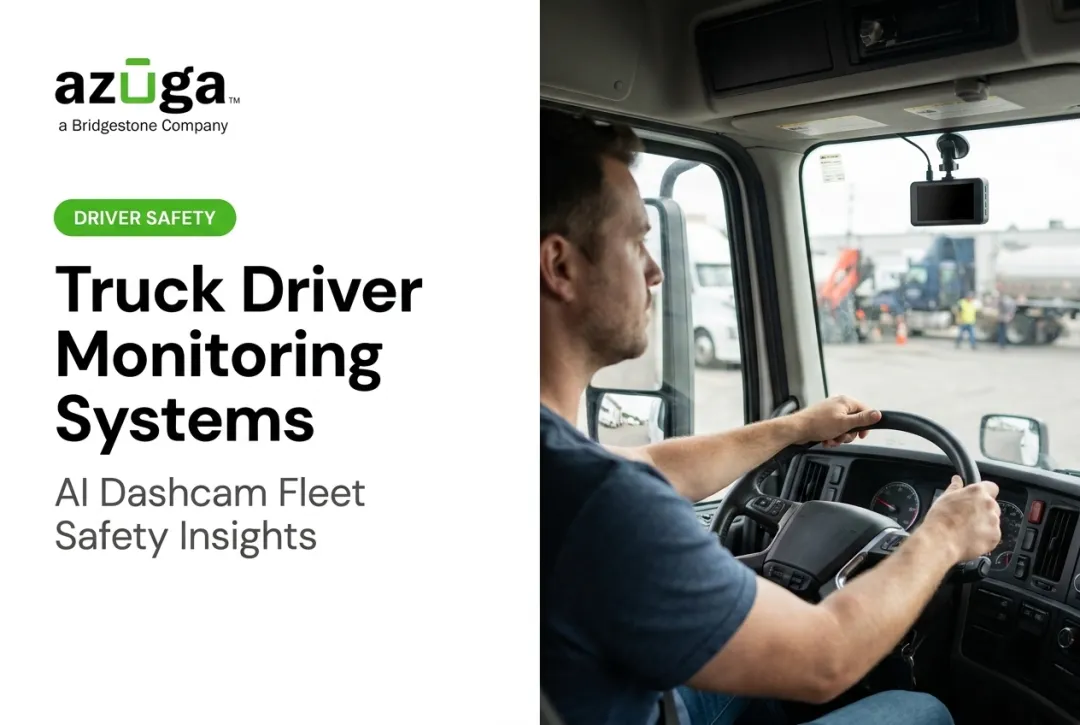
Video telematics adds visual evidence on top of the data. Azuga's Fleet Safety platform combines telematics with dashcams and driver scoring, so fleet managers get footage alongside behavioral metrics.
Industry-wide, video adoption still trails traditional telematics. A 2022 Commercial Carrier Journal estimate put video adoption around 6.5%, versus over 55% for standard telematics. Fleets that add video are still early adopters.
Key Benefits of Truck Telematics for Fleets
Cost Savings
Efficient routing cuts fuel consumption and time on the road. Predictive maintenance catches problems before they become breakdowns.
Azuga customers save an average of $9,462 annually through better fleet cost management. One customer, Reliable Fire & Safety, reported fewer idling events and lower fuel costs within eight months of switching.
Safety Improvements
Driver behavior monitoring paired with coaching changes habits over time. Azuga's Driver Scores flag habits needing improvement, while Azuga Coach delivers online training to reinforce better techniques. Among Azuga customers, those tools deliver
- 38% average reduction in accidents among Azuga customers
- 57% average reduction in speeding citations

Compliance Made Simpler
Hours of Service (HOS) and ELD mandate compliance stop being a manual headache. Azuga eLogs meets or exceeds FMCSA 395.15 regulations for HOS and DVIRs, sending alerts when drivers approach HOS limits or trigger a violation.
Liability Protection
Dashcam footage provides accountability when incidents happen. Azuga's Smart DashCam records two-way footage, giving fleets a documented record rather than a he-said-she-said dispute after a collision.
Productivity Gains
Real-time visibility changes how dispatch operates. Reliable Fire & Safety used Azuga's mobile app to confirm a technician was en route to a Saturday evening appointment — without picking up the phone. Dispatchers resolve status questions in seconds instead of phone tag, which keeps evening and weekend jobs on schedule.
How Much Does a Truck Telematics System Cost?
No single fixed price exists industry-wide — vendors structure costs around subscriptions and add-ons rather than flat rates.
OEM programs follow the same model: Peterbilt's connected features require an active subscription, and International bundles a five-year data plan with its factory-installed device My International.
Main cost components:
- Hardware — device cost varies by GPS-only vs. GPS + dashcam
- Add-ons — dashcams, ELD, fuel card integration, and similar extras
Azuga's tiered plans gives a useful benchmark
| Plan | Packaging | Includes |
|---|---|---|
| BasicFleet | Packages matched to fleet needs | GPS tracking, alerts, driver scores, geofencing |
| SafeFleet | Packages matched to fleet needs | Adds distracted-driving detection, diagnostics, fuel card integration |
| CompleteFleet | Packages matched to fleet needs | Adds Azuga Coach, FuelSaver, one-minute tracking, dedicated Customer Success Manager |
| AI SafetyCam add-on | Packages matched to fleet needs | Optional dashcam layer |
Azuga serves fleets from 5 vehicles up to 50,000+ and prices across five fleet-size brackets, so a five-truck landscaping outfit and an enterprise logistics fleet both get a quote matched to scale—not a one-size package.

Is Truck Telematics Tracking Legal?
Yes. GPS and telematics tracking on company-owned commercial vehicles is legal in the US when used for legitimate business purposes. Federal ELD rules under 49 CFR Part 395 already require capturing vehicle position data for HOS compliance eCFR Part 395.
That said, legality doesn't mean you can skip communication with drivers. Best practice, and in many cases a contractual or state requirement, means
- Informing drivers in writing that telematics and personal data are being collected
- Providing clear notice of your privacy policy
- Obtaining necessary driver consents before activating monitoring
Azuga's platform builds this in: customers must inform end users about data collection before use, and drivers can switch dashcams to privacy mode when off-duty.
Key distinction: tracking a company vehicle for business purposes is a different legal question than tracking a personal vehicle or monitoring an employee outside work hours. The former is standard fleet management. The latter raises separate privacy concerns that vary significantly by state law.
Choosing and Identifying Telematics-Equipped Trucks
Not sure if a truck already has telematics installed? A few quick checks
- Inspect the OBD-II/diagnostic port — look for a device already plugged in
- Check for OEM factory hardware — many manufacturers now build telematics gateways into new trucks
- Ask the dealer or manufacturer directly — they can confirm what's factory-installed versus what needs aftermarket equipment
Major truck OEMs increasingly ship telematics as standard equipment
- International — factory-installed device plus a five-year connected data plan on all new Class 6-8 vehicles
- Peterbilt SmartLINQ — works on trucks from model year 2017 forward with an active subscription
- Volvo Connect — requires a factory-installed 4G gateway

If your trucks lack factory telematics—or you need features OEM systems don't offer—prioritize these aftermarket criteria
- Ease of installation — plug-and-play beats scheduling shop time
- Integration options — check compatibility with your existing TMS or fleet management software
- Support availability — 24/7 access matters when something breaks at 2 a.m.
- Scalability — a system that works for 10 trucks should still work at 100
Azuga is built around those same priorities: the tracker installs in about 20 seconds without professional help, and the platform supports 75+ third-party integrations, from Fleetio to ServiceTitan.
Frequently Asked Questions
What is truck telematics?
Truck telematics combines GPS location tracking, OBD-II or CAN-BUS diagnostics, and cellular communication to monitor vehicle position, engine performance, and driver behavior in real time.
How much does a truck telematics system cost?
As a reference point, Azuga's plans use packages matched to fleet needs, plus optional add-ons.
Is truck telematics used for tracking?
Yes, tracking vehicle location and driver behavior is a core function, alongside engine diagnostics and safety monitoring like harsh braking alerts and idle-time reports.
Is truck telematics legal?
Tracking company-owned commercial vehicles for business purposes is legal in the US. Best practice requires informing drivers in writing and obtaining necessary consents before activating monitoring.
How can I tell if a truck has a telematics system?
Check the OBD-II or diagnostic port for a connected device, or contact the OEM or dealer to confirm whether the truck ships with factory-installed telematics hardware.
Which trucks come with telematics?
Many major OEMs — including International, Peterbilt, Volvo, and Freightliner — now offer factory-installed telematics on newer models. Any truck can also be equipped with aftermarket systems like Azuga's plug-and-play OBD-II tracker.