
One creates a route that works. The other creates the route that costs you the least in fuel, time, and driver hours. Confuse them, and you might be leaving real money on the table every single day.
The distinction affects fuel spend, delivery windows, driver productivity, and your fleet's overall return on investment. This article breaks down what separates the two, where each one fits, and how to figure out which approach (or combination) makes sense for your operation.
Key Takeaways
- Route planning manually sequences stops based on addresses and depot location.
- Route optimization uses algorithms and real-time data to calculate the most efficient route.
- Small fleets with fixed, predictable stops can often manage with planning alone.
- Scaling fleets need optimization to control costs and stay competitive.
- Combining both approaches delivers the biggest gains in cost control and on-time performance.
Route Planning vs Route Optimization: Quick Comparison
The fastest way to see the gap between these two approaches is side by side.
| Factor | Route Planning | Route Optimization |
|---|---|---|
| Process | Manual or experience-based sequencing | Automated, algorithm-driven calculation |
| Key Inputs | Addresses, depot location, basic delivery windows | Addresses, time windows, traffic data, vehicle capacity, driver hours, road restrictions |
| Adaptability | Static: requires manual rework when things change | Dynamic: adjusts in real time for new orders or disruptions |
| Cost Impact | Prone to wasted mileage and fuel | Measurably tighter mileage and time per route |
| Best For | Very small fleets, few predictable stops | Growing fleets, service fleets, multi-stop operations |
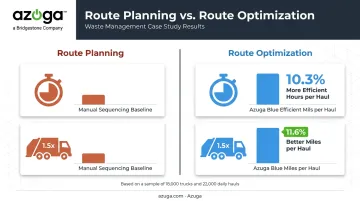
On cost impact specifically, there's no single "average savings" figure that applies to every fleet: the improvement depends heavily on how complex your routes already are. But real deployments show the pattern. Waste Management's algorithm-generated routes came in 10.3% more efficient in hours per haul and 11.6% better in miles per haul, according to a peer-reviewed case study published through INFORMS. The pilots covered roughly 18,000 trucks and 22,000 daily hauls, a large enough sample to trust the numbers.
What Is Route Planning?
Route planning is the process of deciding which stops a driver needs to hit and roughly what order to hit them in. You start with a list of addresses, a depot location, and maybe some basic delivery windows. From there, someone (or some spreadsheet) builds a sequence that gets the job done.
This works fine for service businesses running a manageable number of daily stops. HVAC techs, plumbers, electricians, and pest control operators often plan a day's route by hand or with simple mapping software.
Here's the catch: route planning confirms a route is feasible. It doesn't confirm it's efficient. Manual planning has no built-in way to account for
- Live traffic conditions or road closures
- Driving-hour regulations and required breaks
- Vehicle capacity limits across multiple stops
- Last-minute schedule changes
Some fleets use static planning software instead of pure guesswork, locking in fixed routes for recurring, predictable jobs like waste collection. That's still route planning, just a more organized version of it.
Use Cases of Route Planning
Route planning fits best when the variables stay simple and predictable.
- Single-technician operations: a solo plumber mapping 5-6 daily appointments doesn't need an algorithm
- Fixed recurring routes: waste collection, mail delivery, or regular maintenance rounds with stable stop lists
- Very small fleets: one or two vehicles covering a tight, familiar service area
The limitations show up once complexity creeps in. Waste Management found that planners spent 4-5 hours per site manually building routes. Those routes still violated customer time windows more than 11% of the time and maximum route-time limits more than 28% of the time. Manual sequencing simply can't juggle that many interacting constraints at once.
What Is Route Optimization?
Route optimization uses algorithms and real-time data to calculate the most efficient, cost-effective sequence for a set of stops. Instead of a human eyeballing a map, software runs the numbers on traffic patterns, time windows, vehicle capacity, and driver hours simultaneously.
The operational payoff is concrete
- Lower fuel consumption from tighter, smarter routes
- Reduced vehicle wear from fewer unnecessary miles
- More stops per day without adding vehicles
- Better on-time performance, especially for tight delivery windows
There are two flavors worth knowing. Static optimization plans a route once and reuses it, which works well for stable, repeat schedules. Dynamic optimization continuously recalculates as new orders come in, traffic shifts, or a driver runs behind. Growing fleets almost always need the dynamic version.
Why GPS Data Matters Here
Optimization engines are only as good as the data feeding them. This is where real-time fleet visibility becomes critical.
Azuga's GPS tracking updates at 30-second intervals, feeding live vehicle location and driver behavior data into routing decisions. That frequency matters: a routing engine working off stale location data can only guess at the best route. High-frequency tracking lets dispatchers see exactly where every vehicle sits right now, not where it was ten minutes ago.
Use Cases of Route Optimization
Optimization earns its keep once a fleet is juggling multiple vehicles and moving parts.
- Last-mile delivery: tight time windows and high stop density make manual sequencing impractical
- Service fleets dispatch: technicians for construction, HVAC, and utility fleets have to be balanced against emergency calls
- Multi-stop trucking routes: driver hours-of-service rules add legal constraints planning alone can't handle
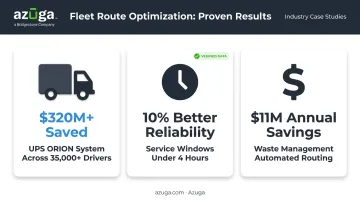
These use cases show up in the data. UPS's ORION system, used by more than 35,000 U.S. drivers, had saved the company more than $320 million by December 2015 through algorithm-driven routing. Waste Management's pilots showed a 10% improvement in service reliability for windows under four hours, showing that optimization improves customer experience as well as internal cost metrics.
Route Planning vs Route Optimization: Which Is Better for Your Fleet?
There's no universal answer here: it depends on what your fleet actually looks like day to day. Weigh these factors
- Fleet size: one or two vehicles versus a dozen-plus
- Route complexity: fixed daily stops versus constantly shifting schedules
- Number of daily stops: five appointments versus fifty deliveries
- Growth plans: are you scaling, or staying steady?
Choose route planning alone if:
- You run a very small fleet with fixed, predictable routes
- Your stop count rarely changes week to week
- You rarely need real-time traffic or driver behavior data
Choose route optimization if:
- You manage multiple vehicles across tight delivery windows
- You're scaling operations and adding stops or vehicles regularly
- You're juggling daily constraints like traffic, capacity, and driver hours
Most growing fleets actually land somewhere in between. They use route planning to define which stops need covering, then apply optimization software to sequence those stops in the most efficient order. Planning answers "what needs to happen." Optimization answers "how do we do it efficiently." Platforms like Azuga combine both capabilities, so you don't have to pick just one.
Real-World Example: Optimization in Action
Kitsap Garage Door Company, an Azuga customer, illustrates the kind of shift service businesses go through as they outgrow manual routing. service operations like garage door repair and installation depend on getting technicians to the right address, at the right time, without wasted drive time eating into billable hours.
The general pattern across Azuga's service fleets customers follows a familiar arc
- Manual scheduling leads to inefficient routing and missed time windows
- Dispatchers lack real-time visibility into where technicians actually are
- Fuel costs climb from unnecessary mileage and idle time
Shifting to a GPS-informed approach solves these problems directly. Live vehicle tracking feeds into dispatch and routing decisions, giving managers real-time visibility they didn't have before.
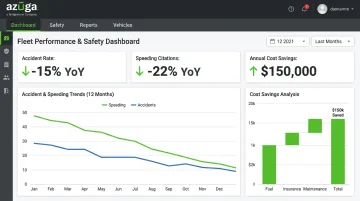
Across Azuga's broader customer base, fleets using the platform's tracking and behavior monitoring tools have seen accidents decrease by an average of 38%, speeding citations drop by 57%, and annual fleet costs fall by roughly $9,462. Operational costs overall have dropped by as much as 30% for some fleets.
Pairing real-time GPS visibility with smarter routing decisions consistently translates into measurable cost and safety improvements, not just faster deliveries.
If your dispatch process still relies on guesswork, Azuga's real-time GPS tracking and driver behavior insights can show exactly where those inefficiencies are hiding.
Conclusion
Route planning and route optimization aren't rivals. Planning defines the "what" — which stops need covering. Optimization defines the "how": the smartest way to actually get there.
Which approach your fleet needs depends on size and complexity, not preference. And regardless of which stage you're at, visibility tools like GPS tracking make optimization dramatically more effective by feeding it accurate, real-time data instead of guesswork.
Frequently Asked Questions
What is the difference between route planning and route optimization?
Route planning maps out which stops to visit and in what general order. Route optimization uses algorithms and real-time data to calculate the most efficient sequence, factoring in traffic, time windows, and vehicle capacity.
Is Google Maps enough for route optimization?
Consumer Google Maps allows up to nine stops with manual reordering, which works for basic multi-stop trips. It lacks commercial features like vehicle constraints, delivery windows, or dynamic real-time rerouting that fleets need.
What factors should be considered when optimizing a route?
Key factors include real-time traffic conditions, delivery time windows, vehicle capacity, driver hours-of-service rules, and road or vehicle restrictions. Each one adds a constraint that manual planning struggles to balance simultaneously.
Can small businesses benefit from route optimization software?
Yes. Once a small fleet manages multiple stops or vehicles, optimization reduces wasted fuel and improves on-time performance. Even a two- or three-vehicle operation can see meaningful savings once complexity increases.
How does GPS tracking improve route optimization?
Real-time GPS data feeds accurate vehicle location and driver behavior into optimization algorithms. This enables dynamic rerouting and more informed dispatch decisions as conditions change throughout the day.
What's the ROI of switching from manual route planning to optimization?
Businesses typically see reduced fuel and operational costs alongside better delivery reliability. Waste Management, for example, reported $11 million in annual efficiency savings after moving from manual to automated route planning.