
That shift matters because the pain points haven't gone away. Fuel costs keep climbing. Unsafe driving habits lead to accidents and citations. Unplanned breakdowns stall jobs and burn revenue. And without real-time visibility, fleet managers are stuck reacting instead of preventing.
This article breaks down how IoT fleet tracking actually works, what components make up a modern system, what it costs, and how to pick the right solution for your fleet.
Key Takeaways
- IoT fleet tracking turns GPS, sensors, and telematics into live vehicle and driver visibility you can act on
- Connected fleets report ~38% fewer accidents, 57% fewer speeding citations, and up to 30% lower operating costs
- Plug-and-play OBD-II devices install in minutes, no technician required
- Choose by fleet size, budget, and must-haves—dashcams, AI safety tools, or simple GPS tracking
What Is IoT Fleet Tracking and How Does It Work?
IoT fleet tracking connects a network of devices (GPS trackers, sensors, and OBD-II hardware) that collect vehicle data and transmit it in real time. Instead of a single daily location update, you get a continuous stream of information about where vehicles are, how they're driven, and what's happening under the hood.
The data flow works in four stages:
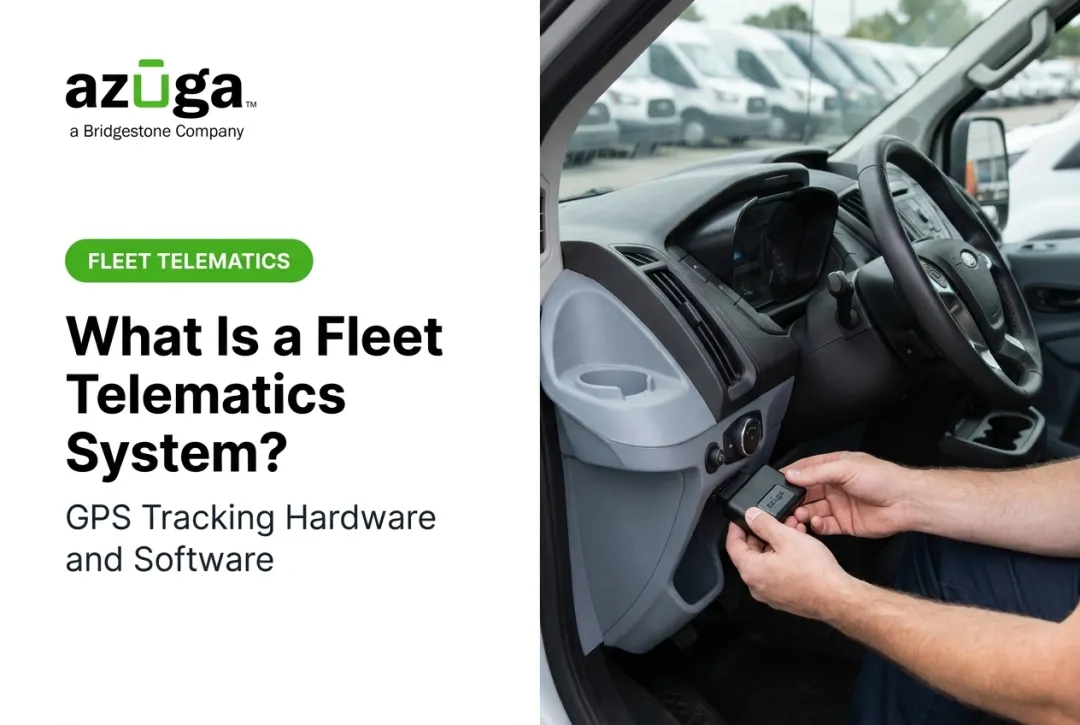
- Collection: A device plugged into the vehicle's OBD-II port reads engine diagnostics, GPS coordinates, and driver behavior events
- Transmission: Data travels over cellular networks to a cloud-based platform
- Analysis: Software processes the incoming data and flags anomalies
- Alerting: Fleet managers get actionable notifications on their dashboard or phone
For example, if a driver slams the brakes hard enough to trigger a harsh-braking event, that data flows through the system within seconds, appearing on the fleet manager's dashboard along with GPS location and speed at the time of the event.

Traditional GPS vs. IoT-Enabled Tracking
Traditional fleet tracking relied on manual logs or basic GPS check-ins every few minutes. IoT-enabled systems push continuous, high-frequency data. Azuga's OBD-II device, for instance, tracks at 30-second intervals. Basic GPS systems don't match that granularity.
As more fleets adopt high-frequency tracking, legacy systems fall further behind. Berg Insight forecasts North America's installed base of fleet-management systems will grow from about 19.2 million active systems in late 2024 to 33.2 million by 2029. That equates to an 11.6% compound annual growth rate. Fleets that stick with legacy tracking are increasingly the exception, not the rule.
Key Components of an IoT Fleet Tracking System
A complete IoT fleet tracking setup isn't just a GPS dot on a map. It's a layered system of hardware and software working together.
Core components include:
- GPS tracking hardware — Real-time location, historical routes, and geofencing so managers know when a vehicle enters or leaves a job site
- Telematics sensors — Engine diagnostics, fuel consumption, tire pressure, and idling time captured continuously
- Dashcams and AI video analytics — Dual-facing cameras that monitor road events and in-cab driver behavior, useful for collision reconstruction
- Centralized dashboard — A single interface aggregating GPS, diagnostics, and video data
- Mobile apps — Give drivers alerts, trip logs, and a direct line to dispatch
Azuga's own device architecture reflects this layered approach. It plugs into the OBD-II port, interfaces with the vehicle's computer and GPS satellites, and adds an optional video camera, transmitting encrypted telematics data back to servers accessible through software or Azuga's FleetMobile app.
The app is included free with every subscription and works on both Apple and Android devices, letting drivers log hours of service and communicate with dispatch directly from their phone.

Core Benefits of IoT Fleet Tracking Solutions
IoT fleet tracking pays off across safety, uptime, fuel, and compliance—not just a single KPI. The gains below are typical of what connected fleets measure once GPS, sensors, and video work together.
At a glance:
- Fewer accidents and speeding events through real-time coaching
- Less unplanned downtime from early maintenance alerts
- Lower fuel spend via idle and route control
- Cleaner ELD/HOS records and stronger liability defense
Improved Driver Safety
Real-time monitoring of speeding, harsh braking, and distracted driving lets managers coach drivers before small habits become crashes. Fleets on Azuga see a 38% average reduction in accidents and a 57% drop in speeding citations.
Independent research points the same way. A U.S. DOT field study of Class 8 trucks found sleeper-cab drivers using telematics with coaching cut miles driven above 65 mph by 42%, with a 5.4% fuel-economy gain.
Predictive Maintenance
Those same connected vehicles surface engine and component issues before a roadside failure. After adopting GPS fleet tracking, Azuga customers report a 53% reduction in fleet wear and tear—which means fewer surprise repairs and less downtime.
Fuel and Operational Cost Savings
Safety and uptime matter, but fuel is often the fastest line-item win. Cutting idle time and using route data lowers burn directly. The EPA notes that ending unnecessary idling on a typical long-haul truck can save over 900 gallons of fuel a year. Azuga customers save an average of $9,462 per year through stronger fleet cost control.
Regulatory Compliance and Liability Protection
Automated logs simplify ELD and hours-of-service reporting. When a crash does occur, AI collision reconstruction helps shield drivers from unfair blame. Azuga SafetyCam AI has shown that 70% of accidents involving its customers were not the driver’s fault—evidence that can head off costly litigation.

How Much Does IoT Fleet Tracking Cost?
Pricing depends on fleet size, number of devices, and which features you need. Basic GPS tracking costs less than a plan with AI dashcams and collision reconstruction bundled in.
Published industry examples show a wide range depending on hardware and service level. Azuga's plans use packages matched to fleet size and features
| Plan | Packaging | Features |
|---|---|---|
| BasicFleet | Packages matched to fleet needs | Core GPS tracking, live map |
| SafeFleet | Packages matched to fleet needs | Adds SpeedSafe, distracted-driving detection, panic alerts |
| CompleteFleet | Packages matched to fleet needs | GPS tracking plus full safety feature stack |
| SafetyCam AI add-on | Packages matched to fleet needs | Optional AI dashcam and collision reconstruction |
Most providers, Azuga included, use packages matched to fleet needs that scales with fleet size rather than a flat rate. An operation with 5 vehicles pays differently than one running 500.
Upfront hardware costs stay minimal with self-installable OBD-II devices, which skip the professional installation fees that wired systems often require.

Choosing the Right IoT Fleet Tracking Solution
Not every fleet needs the same setup. A few factors should drive the decision
- Installation complexity: Plug-and-play OBD-II devices install in about 20 seconds with no technician needed; wired installations take longer and cost more upfront
- Feature depth: GPS tracking, dashcams, driver scorecards, and integrations with fuel cards or maintenance software—matched to how you run the fleet
- Support and reputation: Choose vendors with proven customer satisfaction and reliable ongoing support
- Scalability: Grow from a 5-vehicle small business to an enterprise fleet running tens of thousands of vehicles
Azuga holds G2 Leader recognition across categories and counts customers like Kitsap Garage Door Company, whose president reported immediate benefits after switching from a traditional GPS system to gain visibility into idling and fuel use.
One practical note: vehicles built after 1996 generally have a compatible OBD-II port for plug-and-play devices. Older vehicles or large trucks without that port typically need a hardwired install instead.
Frequently Asked Questions
How much does fleet tracking cost?
Costs vary by fleet size and features. Azuga provides packages that scale with your fleet size, hardware, and features.
What is IoT in vehicles?
IoT in vehicles means internet-connected sensors and devices (GPS, telematics, OBD-II hardware) that collect real-time data. That data covers location, vehicle performance, and driver behavior.
How does IoT fleet tracking improve driver safety?
IoT fleet tracking sends real-time alerts for speeding, harsh braking, and distracted driving. Managers can coach drivers before those habits lead to an accident.
Can IoT fleet tracking help with vehicle maintenance?
Yes. Engine diagnostics and sensor alerts flag potential issues, like failing components, before they cause a breakdown, reducing costly downtime.
Is IoT fleet tracking suitable for small businesses?
Yes. Scalable, affordable plans exist for small fleets and can grow alongside the business without requiring a new contract for each added vehicle.
What industries benefit most from IoT fleet tracking?
Construction, HVAC, trucking, utilities, and service businesses all rely on fleet visibility to manage safety, fuel costs, and job-site logistics.