
Many businesses lump "fleet manager" and "fleet safety manager" into the same job description. That's a mistake. Hiring, org charts, and accountability all suffer when nobody owns safety specifically.
This article breaks down what a fleet safety manager actually does, the skills and certifications the role calls for, and the technology (GPS tracking, dashcams, telematics) that makes the job possible in 2025.
Key Takeaways
- Fleet safety managers own driver behavior, compliance, and risk—not asset or cost management
- The role blends DOT/FMCSA regulatory knowledge with coaching and data analysis
- Telematics, AI dashcams, and MVR monitoring are now standard equipment for the job
- Smaller fleets often combine safety duties with a fleet or operations manager role
What Is a Fleet Safety Manager?
A fleet safety manager develops, implements, and enforces the safety policies and compliance standards that govern a company's vehicles and drivers. This specialized role sits apart from general HR duties, focusing entirely on reducing crashes, injuries, and liability tied to vehicle operations.
Where the role sits in an organization depends heavily on company size
- Enterprise fleets typically have a fleet safety manager reporting to a Director of Fleet or VP of Operations, working alongside (not under) a separate fleet manager
- Mid-size fleets may have a hybrid title, such as "Fleet & Safety Manager," reporting directly to operations leadership
- Small fleets often fold this function into an owner's or operations manager's existing responsibilities
Industries That Rely on This Role
Fleet-based businesses across construction, trucking, utilities, HVAC, waste management, and telecom all depend on vehicles as core operating assets. That level of exposure is exactly what justifies dedicated safety leadership.
NAFA Fleet Management Association explicitly counts construction and utility operators among its represented sectors. NATMI builds its safety-director credentials specifically around trucking and bus fleet management.
What sets this role apart from a general workplace safety officer is the specific mix of skills required: DOT/FMCSA regulatory fluency, people management, and the ability to read telematics data. A workplace safety officer worries about slips and falls in a warehouse. A fleet safety manager worries about hours-of-service violations, harsh braking events, and motor vehicle record reviews.
Key Responsibilities of a Fleet Safety Manager
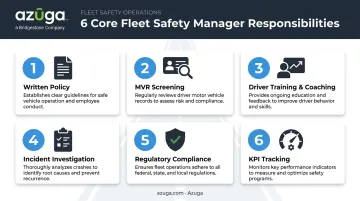
The job breaks down into six core functions, and none of them are optional if a company wants to stay compliant and reduce claims.
- Building and enforcing a written fleet safety policy covering distracted driving, seatbelt use, phone restrictions, and minimum vehicle standards
- Screening and monitoring drivers through Motor Vehicle Record (MVR) checks — not just at hiring, but on a recurring basis for every current driver
- Running driver training and coaching programs, using telematics and video data to flag drivers who need intervention for speeding, harsh braking, or distraction
- Investigating incidents and accidents, documenting root causes, and using collision data to determine fault and prevent repeat occurrences
- Maintaining regulatory compliance with DOT and FMCSA rules, including audit-ready documentation for roadside inspections
- Tracking safety KPIs like accident rate, speeding events, and idle time, then reporting trends to leadership
FMCSA regulations require motor carriers to review each covered driver's MVR at least once every 12 months. That review must be documented with a reviewer name and date in the driver qualification file for three years. Missing this review turns a safety gap into a documented compliance violation, the kind that surfaces quickly during a roadside audit.
The KPI-tracking piece matters more than it sounds. Insurers increasingly treat certain risk-control signals as underwriting factors for commercial auto policies, including
- MVR review consistency and audit-ready documentation
- Driver training and coaching program participation
- Telematics adoption and monitoring frequency
A fleet that can show consistent coaching data and low speeding-event counts sits in a stronger negotiating position than one that can't.
Skills, Qualifications & Certifications Fleet Safety Managers Need
There's no single degree path that produces a fleet safety manager. Most people grow into the role from operations, logistics, or safety backgrounds, then build specific expertise on the job.
Core hard skills include:
- Reading and interpreting telematics, MVR, and CSA data
- Working knowledge of DOT and FMCSA regulations
- Building safety reports and dashboards leadership can act on
Soft skills matter just as much, particularly coaching. A driver who gets defensive during a coaching conversation won't change behavior, no matter how good the data is. This is a documented gap in the industry: SambaSafety reports that 63% of fleet safety leaders say they want to improve their coaching abilities. Data literacy without communication skill only gets a safety program halfway there.
Certifications Worth Considering
A handful of credentials exist, though none are mandatory
- NAFA's Certified Automotive Fleet Manager (CAFM): broad, covering eight fleet disciplines including risk management
- NATMI's Certified Director of Safety (CDS): specifically focused on motor-fleet safety policy and leadership, requiring five years of experience (or four with a degree) plus a 100-question exam
- OSHA fleet safety courses: useful training resources, though OSHA doesn't issue a formal fleet safety manager certification
These credentials work best as proof of experience already built on the job, not a substitute for it.
Tools & Technology Fleet Safety Managers Rely On
Modern fleet safety work is built on data, and the technology stack has changed the job substantially over the past decade.
GPS fleet tracking is the foundation. It gives real-time visibility into vehicle location, speed, and driver behavior. Refresh frequency matters here. Azuga's platform updates every 30 seconds, fast enough to correlate exactly where a harsh-braking event happened with what the driver was doing at that moment, rather than relying on vague location approximations.
AI dashcams and video telematics add a visual layer. The National Transportation Safety Board has found that onboard video supplies objective evidence of driver actions and roadway conditions, invaluable during crash investigations.
Azuga's SafetyCam AI dashcam pairs 1080p dual-facing video with collision reconstruction technology, combining telematics data (speed, braking, GPS) with footage to reconstruct what happened. Azuga reports this capability helps prove 70% of accidents are not the fault of the driver, a critical number when a single unfounded claim can trigger six-figure litigation exposure.
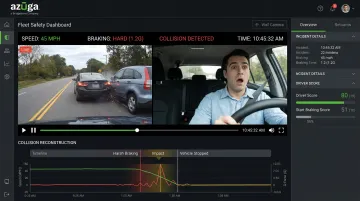
Driver scorecards round out the coaching toolkit, flagging
- Speeding relative to posted limits
- Harsh braking and sudden acceleration
- Distraction events (calls made or received while driving)
- Seatbelt usage, where vehicle data supports it
MVR/CSA monitoring platforms and maintenance software keep the compliance side running, tracking driver qualification files, engine diagnostics, and inspection schedules so nothing falls through the cracks during a DOT audit.
Azuga's fleet management platform brings these pieces together in one system: a self-installable OBD-II tracker, SafetyCam AI dashcams, and driver scorecards, accessible for smaller fleets without a dedicated IT team. Fleets using the platform have reported decreased accidents by an average of 38% and reduced speeding citations by 57%.
Fleet Safety Manager vs. Fleet Manager: What's the Difference?
These titles get used interchangeably, but they cover different ground.
| Focus Area | Fleet Manager | Fleet Safety Manager |
|---|---|---|
| Primary concern | Asset lifecycle, fuel, logistics, cost | Driver behavior, compliance, risk reduction |
| Success metric | Total cost of ownership, uptime | Accident rate, speeding events, compliance status |
| Data used | Telematics for efficiency and routing | Telematics for coaching and violation prevention |
| Regulatory tie-in | Vehicle registration, maintenance schedules | DOT/FMCSA driver files, MVR reviews, HOS limits |
Both roles pull from the same telematics data, but they apply it differently. A fleet manager looks at idle time to cut fuel costs. A fleet safety manager looks at the same idle-time data alongside harsh-braking events to identify a driver who needs coaching.
How that data gets used often comes down to team structure. Small-to-mid-size fleets frequently combine both titles into a single "Fleet Manager" who wears both hats. Enterprise fleets, especially those in trucking or construction with hundreds of vehicles, tend to split the roles so each specialist can focus fully on their domain.
Why Every Fleet Needs a Dedicated Safety Manager
The financial case is straightforward. That same NETS analysis found an average employer cost of $26,081 per on-the-job highway crash, factoring in property damage, injury, and fatal incidents. Multiply that across a fleet with even a modest crash rate, and the math justifies dedicated safety leadership on cost alone, before factoring in insurance premiums or litigation exposure.
There's a culture dimension too. When nobody owns safety specifically, enforcement gets inconsistent and drivers receive mixed messages about what actually matters. A named safety leader creates accountability, reinforces expectations, and gives drivers someone to answer to (and be coached by) when patterns emerge.
Technology amplifies what one person can accomplish. Fleets using Azuga's platform have reported
- 38% decrease in accidents on average
- 57% reduction in speeding citations
- 30% reduction in operational costs
- $9,462 in annual savings from more effective fleet cost management
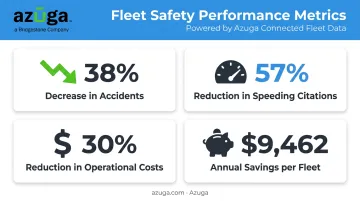
A dedicated safety manager and the right telematics platform work as one system: the manager sets accountability, the technology supplies the data to act on it, and fleets see the cost and risk reductions above as a result.
Frequently Asked Questions
What does a fleet safety manager do on a daily basis?
Daily work typically includes reviewing telematics alerts for harsh braking or speeding, coaching flagged drivers, checking compliance documentation, and investigating any incidents reported overnight.
What is the difference between a fleet manager and a fleet safety manager?
A fleet manager focuses on asset costs, maintenance, and logistics, while a fleet safety manager focuses on driver behavior and regulatory compliance. Smaller fleets often combine both into one role.
What tools does a fleet safety manager use?
Core tools include GPS telematics, AI dashcams for video evidence, MVR (Motor Vehicle Record) monitoring platforms, and driver scorecards that flag speeding, harsh braking, and distraction trends.
What certifications should a fleet safety manager have?
NAFA's CAFM, NATMI's Certified Director of Safety, and OSHA fleet safety courses are the most recognized options, though none are legally required to hold the job.
What makes a great fleet safety manager?
Strong communicators who can read data and turn it into coaching conversations, rather than just compliance reports, tend to see the biggest safety improvements across their fleets.
Do small businesses need a dedicated fleet safety manager?
Small fleets often combine the role with fleet or operations management, but someone still needs clear, named ownership of safety, even if it's not their only job.