
The numbers back this up. A U.S. Department of Labor estimate cited in Azuga's fleet safety research found a crash occurs every 5 seconds and an injury every 10 seconds. Commercial auto insurance costs have climbed for eight straight years as losses have grown.
Commercial fleet telematics systems combine GPS, vehicle diagnostics, and software to give fleet managers real-time visibility into where vehicles are, how they're being driven, and when they need maintenance. This article covers how these systems work, the device types available, what benefits to expect, and how to pick the right one.
Fleets that pair telematics with driver coaching see real results. Azuga customers, for example, report a 38% average decrease in accidents and 57% fewer speeding citations.
Key Takeaways
- GPS, OBD-II/CAN bus data, and cloud software give fleets live location, driver behavior, and vehicle-health visibility
- Fleets cut accident risk, fuel spend, and compliance workload once telematics is in daily use
- Hardware spans basic GPS trackers, OBD-II plug-ins, and AI dash cams
- Match the system to fleet size, industry needs, and your biggest operational pain point
What Is Commercial Fleet Telematics and How Does It Work?
Telematics blends two words: telecommunications and informatics. In practice, it's a small device installed in a vehicle that captures data and sends it to fleet software in near real time.
A typical telematics device includes
- GPS receiver for location tracking
- Engine interface (usually an OBD-II or CAN bus connection)
- SIM card and modem for cellular data transmission
- Accelerometer to detect harsh braking, acceleration, and impacts
How Data Moves From Vehicle to Dashboard
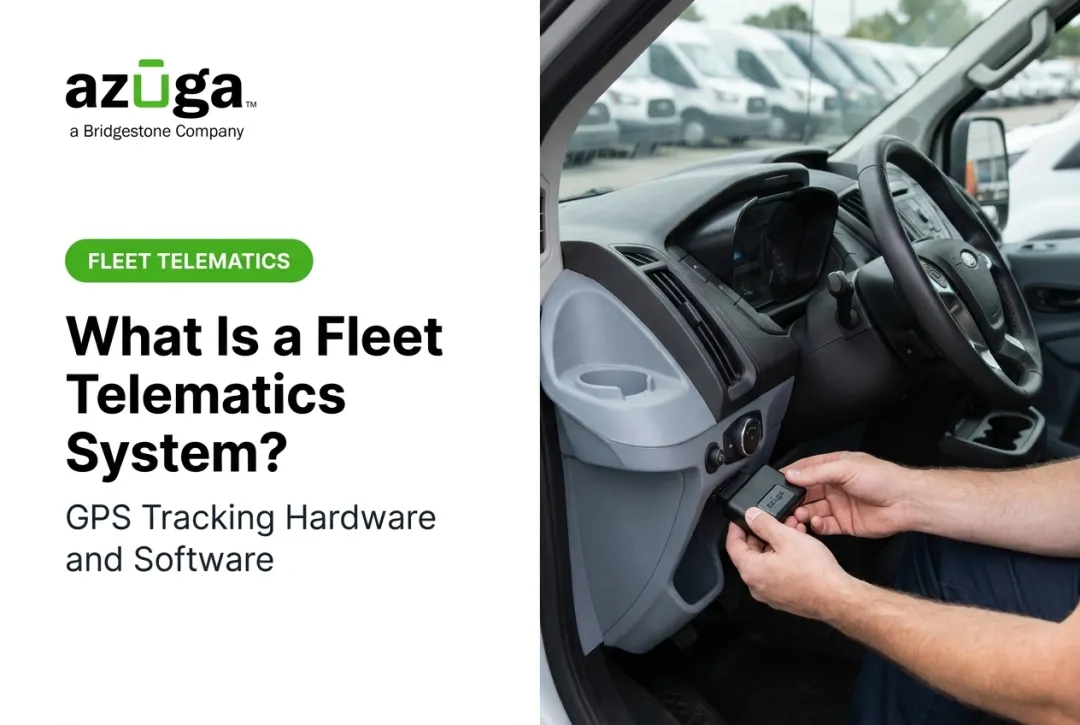
The device plugs into the vehicle's OBD-II port, pulling data directly from the engine's computer. It transmits that information, encrypted, over a cellular network to cloud servers. From there, software translates raw numbers into dashboards and reports fleet managers use every day.
What gets captured?
- Vehicle location and speed
- Harsh braking and sudden acceleration events
- Idling time and fuel consumption
- Engine diagnostics (check-engine alerts, tire pressure, battery status)
- Seatbelt use
How often that data updates depends on the hardware. Azuga's OBD-II device, the Azuga Tracker, plugs in in about 20 seconds—no install appointment—and reports at 30-second intervals, finer than older systems that ping only every few minutes.
Open platforms keep that data from sitting in a silo. Many fleets pipe telematics into dash cams, ELDs, fuel cards, and dispatch tools. Azuga's integration marketplace connects with 75+ platforms—including ServiceTitan, Procore, and Fleetio—so location, safety, and maintenance signals show up where teams already work.

Types of Commercial Fleet Telematics Devices
Not every fleet needs the same hardware. Here's how the main categories break down.
- Battery-powered/standalone GPS units: Compact trackers for asset recovery on trailers, generators, or other unpowered equipment. The Azuga Long Life Asset Tracker is built for extended battery life on these assets.
- Mobile app-based telematics: Uses a smartphone's built-in GPS and sensors. Cheapest entry point, but reliability drops if drivers forget the app or the phone dies.
- OBD-II plug-in devices: Most common choice for commercial fleets. Self-installable, capture engine diagnostics and driving behavior, and need no technician. Azuga's GPS Tracker plugs in and goes live immediately.
- Professional-fit black box/CAN bus adapters: Wired into the vehicle's CAN bus. Harder to tamper with and pull richer engine data—best for larger fleets that need audit-proof records.
- AI dash cameras: Combine video with GPS and telematics data. Fleet managers use them to coach risky behavior and to protect good drivers after incidents.
Azuga SafetyCam AI with Collision Reconstruction has shown that 70% of accidents aren't actually the driver's fault. That's a meaningful liability shield, not just a coaching tool. Many fleets don't pick just one device type. A trucking company might run OBD-II trackers fleet-wide and add dash cams to its highest-risk routes.

Key Benefits of Fleet Telematics for Commercial Businesses
Improved Safety and Accident Reduction
Speeding remains a major driver of fatal crashes. NHTSA's 2023 data recorded 11,775 speeding-related fatalities, accounting for 29% of all U.S. traffic deaths. Telematics systems flag speeding, harsh braking, and distracted driving in real time, so managers can coach before a habit becomes a crash.
Fleets using Azuga's safety platform see 38% fewer accidents on average, from combining behavior data with driver scoring and coaching tools.
Lower Operational Costs
- Reduced idling cuts fuel waste (pest control fleets using Azuga saw a 29% drop in idle time)
- Predictive maintenance alerts catch problems before they become breakdowns
- Cut vehicle and equipment deterioration by roughly half (Azuga fleet data)
Faster Accident Response and Liability Protection
GPS location data paired with dash cam footage speeds up claims processing. It also helps exonerate drivers who weren't at fault. That matters because personal-vehicle drivers cause most accidents involving commercial vehicles, yet fleets often absorb the blame and cost.
Compliance and Productivity
Telematics supports hours-of-service reporting, mileage tracking, and drive-time logs, cutting down on manual paperwork. Real-time visibility also means better dispatching: accurate ETAs, faster route adjustments, and fewer customer service headaches.
Real-world proof: Azuga customers save an average of $9,462 annually through better fleet cost management and see a 57% drop in speeding citations.

The Business Risk Telematics Helps Address
Vehicle incidents are a serious financial exposure, not a minor operational hassle. FMCSA's crash-cost methodology puts comprehensive costs, in 2023 dollars, at:
For trucking specifically, litigation costs have spiked. ATRI's research found verdicts over $1 million went from 26 cases in a five-year window to nearly 300 in the following five years, with award sizes growing over 50% annually — far outpacing general inflation.
Even one serious accident can threaten a small or mid-sized fleet's finances. That's why proactive risk management, not just reactive insurance coverage, has become standard practice for fleets. Azuga's insurance partners have reported accident frequency and severity reductions of up to 50% across more than 25,000 monitored vehicles.
Industries That Benefit Most from Fleet Telematics
Different fleet types lean on different features
| Industry | Primary telematics use |
|---|---|
| Construction & heavy equipment | Asset tracking, equipment utilization |
| HVAC, electrical, plumbing | Routing efficiency, dispatch accuracy |
| Trucking & logistics | Compliance, hours-of-service, fuel optimization |
| Landscaping, pest control | Idling reduction, route optimization |
| Utilities | Compliance reporting, driver safety |
| Waste management, towing | Real-time dispatch, GPS accuracy |

service fleets (HVAC, plumbing, electrical) tend to prioritize routing and dispatch—finding the nearest available technician and sending accurate ETAs. Long-haul trucking leans harder on compliance and fuel data.
Pest control fleets running Azuga saw a 31% drop in speeding events and a 36% reduction in hard braking. Smaller fleets see the same kind of measurable safety gains.
How to Choose the Right Telematics System for Your Fleet
Before comparing vendors, work through these selection criteria
- Identify your priority: safety, fuel cost, compliance, or routing efficiency
- Match complexity to fleet size: a 5-vehicle plumbing outfit doesn't need the same setup as a 200-truck logistics operation
- Check installation requirements: self-install OBD-II devices save time and money versus professional installs
- Confirm integration options: does it connect with your existing fuel cards, dispatch software, or accounting tools?
- Ask about contract flexibility and scalability: can the system grow with you without a full re-purchase?
- Evaluate ongoing support: is help available when something breaks at 9 p.m. on a Friday?
Azuga maps to these criteria with a self-install OBD-II device, packages matched to fleet needs that scales with fleet size, and 24/7 phone, email, and web support.
Reliable Fire & Security, one Azuga customer, reported getting twice the benefits at the same cost after switching platforms. Not every telematics system delivers equal value for the price.
Frequently Asked Questions
What are examples of telematics?
Common examples include GPS fleet tracking devices, OBD-II diagnostic tools, dash cam-based safety systems, and usage-based insurance telematics that adjust premiums based on driving behavior.
What is a telematic sensor?
A telematic sensor is hardware inside a telematics device, such as a GPS receiver or accelerometer, that captures location, speed, or harsh braking events.
What does telematics mean on car insurance?
Usage-based insurance programs use telematics data on driving habits, collected through an app or plugged-in device, to set premiums based on actual behavior rather than broad risk categories.
What is a telematic solution?
A telematic solution combines hardware, software, and a data platform to monitor and manage vehicles, drivers, and assets from one central system.
Is fleet tracking legal?
Yes, tracking employer-owned vehicles is legal in the U.S. Several states require prior notice to employees, so check your state's specific electronic monitoring laws before rolling out a program.
How do I tell if a car has a telematics system?
Check the owner's manual or dashboard menu for factory-installed telematics. On fleet vehicles, also look for an aftermarket OBD-II dongle or tracker under the dash near the steering column.