
That fragmentation creates blind spots. A harsh-braking alert with no video context. A missed oil change that turns into a roadside breakdown. A compliance audit that eats up a week of someone's time.
Integrated fleet management software solves this by pulling GPS tracking, driver safety, maintenance, fuel data, and compliance documentation into one platform. This guide breaks down what integrated systems actually do, the components that make them work, and how to evaluate a solution for your fleet.
Key Takeaways
- Integrated platforms combine GPS, safety, maintenance, fuel, and compliance data into a single real-time dashboard.
- Fleets using connected safety monitoring have reported accident reductions of up to 38% and speeding citation drops of 57%.
- Disconnected tools delay decisions and increase audit and liability risk.
- The best platform prioritizes easy installation, scalability, and reliable support over a long feature list.
What Is Integrated Fleet Management Software?
Integrated fleet management systems (IFMS) combine hardware, such as GPS devices, dashcams, and sensors, with software modules that monitor vehicles, drivers, and assets from a single dashboard. The U.S. Department of Energy defines telematics as near-real-time GPS and onboard-diagnostic data sent to a cloud platform, and that's the foundation every integrated system builds on.
Here's the distinction that matters: a standalone GPS tracker tells you where a truck is. An integrated system tells you where it is, how the driver got there, whether the engine needs attention, and whether that trip complies with hours-of-service rules, all in one place.
Research from ABI Research found that among more than 300 fleet-software decision-makers, 72.5% ranked real-time shipment tracking among their top priorities, yet 62.4% still struggled with data capabilities. The real bottleneck isn't collecting the data — it's connecting it across systems into something fleet managers can actually use.
How the Integration Actually Works
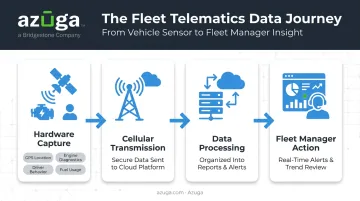
Hardware collects raw data. That data flows into a centralized dashboard for live monitoring and historical trend analysis. Here's a simplified version of that flow
- Hardware captures data — location, engine diagnostics, driver behavior, fuel usage.
- Data transmits via cellular network to a secure cloud platform.
- The platform processes and organizes that data into reports, alerts, and dashboards.
- Fleet managers act on real-time alerts or historical trends.
Once that workflow is running, the scope of integration typically scales with fleet size. A five-vehicle plumbing company doesn't need the same setup as a 500-truck logistics operation, which is why most providers offer customizable, modular packages instead of one-size-fits-all bundles.
Installation used to be the barrier. Not anymore. Azuga's OBD-II tracker, for example, plugs into a vehicle's diagnostic port and starts transmitting data in about 20 seconds, skipping the wiring and technician visits older systems required, with virtually no downtime. That kind of plug-and-play setup is a big reason integrated systems have become accessible even for small businesses without dedicated IT teams.
Key Components of an Integrated Fleet Management System
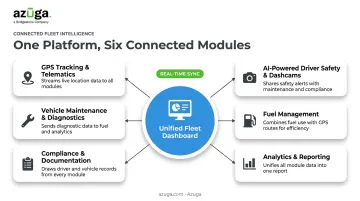
A comprehensive IFMS combines several interconnected modules running off a shared data layer, so information from one feature informs decisions in another.
GPS Tracking & Telematics
Real-time location tracking and geofencing form the backbone of any fleet platform. Higher-frequency tracking, updating every 30 to 60 seconds instead of every few minutes, produces more accurate ETAs and faster route-deviation alerts.
- Geofencing flags unauthorized vehicle use or off-route stops.
- Route optimization shortens delivery windows and cuts unnecessary mileage.
- Faster refresh rates mean dispatchers catch problems before customers do.
AI-Powered Driver Safety & Dashcams
AI dashcams detect distraction, harsh braking, and fatigue in real time, then flag video clips for review instead of forcing managers to sift through hours of footage. Fatigue detection matters more than people realize: the National Safety Council notes fatigued drivers are three times more likely to be in an accident.
Collision reconstruction technology takes this further by piecing together video and telemetry after an incident to establish what actually happened. Azuga customers using SafetyCam AI with Collision Reconstruction have found that 70% of accidents are not the fault of the fleet driver — a distinction that matters enormously for insurance claims and litigation.
Context from federal crash data backs up why fault attribution is tricky. In two-vehicle truck and passenger-vehicle crashes, FMCSA's Large Truck Crash Causation Study assigned the critical reason to the passenger vehicle 56% of the time and to the truck 44% of the time. Without video evidence, fleets are often left arguing against assumptions.
Vehicle Maintenance & Diagnostics
Onboard diagnostics flag issues like low battery voltage or check-engine faults before they become breakdowns. Instead of waiting for a driver to report a problem, the system pushes an alert the moment a diagnostic trouble code appears.
- Automated scheduling triggers service reminders based on mileage or engine hours.
- Fleet managers can view live vehicle health status from a mobile app.
- Early alerts reduce the odds of a vehicle failing mid-route.
Fuel Management
Integrated fuel monitoring identifies waste from idling, harsh acceleration, and inefficient routing, then ties it back to specific drivers or vehicles. A 2018 UC Davis Institute of Transportation Studies review found instantaneous driver feedback improved fuel economy by an average of 6.6%. Aggressive driving, meanwhile, can cut fuel economy by 15% to 30% at highway speeds.
That's the case for pairing fuel data with driver coaching rather than just tracking gallons purchased.
Compliance & Documentation
Manual paperwork is where fleets lose the most time and take on the most risk. Integrated platforms automate hours-of-service tracking, driver vehicle inspection reports, and mileage logs, replacing paper logbooks with searchable digital records.
Azuga's eLogs solution, for instance, meets FMCSA 395.15 requirements and alerts managers before drivers hit HOS limits, removing the need for manual duty-status audits.
Analytics & Reporting
Every module feeds into centralized dashboards that turn raw data into decisions. Instead of pulling separate reports for safety, fuel, and maintenance, managers see one view that shows how those factors interact, like whether harsh-braking events correlate with a specific route or vehicle.
Business Benefits of Integrated Fleet Management
The value of integration shows up in the numbers, not just the workflow.
Reduced accidents and safety incidents. Fleets using connected safety monitoring have reported average accident reductions of 38% and speeding citation decreases of 57%. Acree Air Conditioning saw accidents drop from two to zero and average driver scores climb from 84 to 94 after implementing telematics-based coaching.
Lower operational costs. Better fleet cost management has helped businesses save an average of $9,462 annually, with some fleets reducing overall operational costs by 30%. Diamond Engineering used asset tracking and driver behavior data to negotiate a 10%+ discount on its commercial insurance premium.
Improved productivity. Route optimization and automated dispatching cut delivery windows and free up administrative time previously spent cross-referencing spreadsheets.
Stronger regulatory compliance. Automated tracking of HOS, inspections, and mileage reduces the odds of fines tied to missing or inaccurate records.
Smarter decision-making. Predictive maintenance alerts and AI-driven safety insights let managers act on risk before it becomes an incident, rather than reviewing it after the fact.
Reduced environmental impact. Less idling and optimized routes lower fuel consumption. In one EPA SmartWay case, Associated Food Stores used network optimization to reduce fleet size by 38% and save roughly 62,000 gallons of fuel annually.
The Hidden Costs of Disconnected Fleet Systems
Separate GPS trackers, dashcams, fuel cards, and spreadsheets don't just create inconvenience. They create blind spots that cost money.
Correlation gaps. A harsh-braking event with no matching video clip is nearly useless for coaching or insurance disputes. Siloed systems can't connect the dots between what happened and why.
Maintenance risk. Fleets that rely on disconnected, reactive maintenance tracking miss early warning signs that connected diagnostics would catch. Without real-time engine data and diagnostic alerts, small issues turn into roadside breakdowns, and breakdowns turn into missed jobs and unplanned repair bills.
Compliance exposure. Pulling together driver logs, inspection records, and insurance documents during an audit becomes slow and error-prone when they live in different systems. That's not a small risk. IFTA jurisdictions audit an average of 3% of accounts annually, and late or inaccurate filings can trigger penalties of $50 or 10% of the delinquent tax, whichever is greater.
Fleets running disconnected tools often don't notice these gaps until an audit, accident, or insurance dispute forces the issue.
How to Choose the Right Integrated Fleet Management Solution
Not every fleet needs the same setup. Here's what actually matters when evaluating providers.
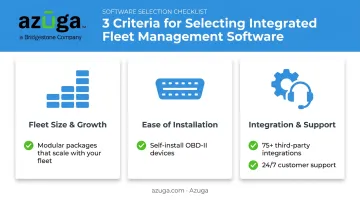
Assess your fleet's size and growth plans.
- Look for scalable, modular packages instead of rigid, one-size-fits-all pricing.
- Confirm the provider supports fleets from a handful of vehicles up to enterprise scale.
Prioritize ease of installation and use.
- Install OBD-II devices yourself, eliminating the need for professional installers and reducing vehicle downtime.
- Expect fleet-wide deployment in under a minute since devices plug in and start working immediately.
Evaluate integration capabilities and support.
- Check compatibility with existing fuel cards, ELDs, or third-party platforms like Fleetio or ServiceTitan.
- Confirm availability of 24/7 phone, email, and web support, not just business-hours help desks.
- Ask whether the provider offers a dedicated account manager for larger fleets.
Frequently Asked Questions
What are integrated fleet management solutions?
They combine software, hardware, and telematics into one platform to monitor vehicles, drivers, fuel, and maintenance in real time. Instead of separate tools, everything runs through a single dashboard.
What is the difference between fleet management and integrated fleet management?
Standalone fleet management tools handle one function, like GPS tracking. Integrated systems consolidate multiple data streams — safety, fuel, maintenance, and compliance — into one connected platform.
How does integrated fleet management improve driver safety?
AI dashcams detect distraction, fatigue, and harsh braking in real time, while collision reconstruction technology helps establish fault after an incident. Combined with manager coaching, this reduces risky driving behavior.
Is integrated fleet management software affordable for small businesses?
Yes. Most providers, including Azuga, offer packages matched to fleet needs designed to work for fleets with just a few vehicles as well as large enterprise operations.
Can integrated fleet management systems work with my existing fuel cards or ELD?
Most modern platforms support integrations with third-party fuel card providers and compliance tools. Confirm specific compatibility with your provider before switching systems.
How long does it take to install an integrated fleet management system?
Plug-and-play OBD-II devices can be self-installed in under a minute per vehicle. There's no need to schedule professional installation or take vehicles out of service.